 Domain NamesFind and register your ideal domain name instantly.
 Web HostingEasy-to-use hosting powered by cPanel — ideal for managing websites in Nigeria.
 Windows HostingRun .NET apps with Windows-optimized hosting
 Affiliate ProgramMake money promoting our services
 Reseller HostingMake money by reselling our hosting products under your own brand
 .COM Domains
 All DomainsExplore all supported tld domains in Nigeria
 WhoisFind out who owns any domain, as well as verify your registration details
 VPS Hosting in Nigeria
 Dedicated ServersReimagine your site speed with your own complete server
 Website BuilderDesign your site with drag-and-drop tools
 Online Store BuilderStart your online shop without code
 SSLs
SSLs Support PortalFind answers or get expert help
 Contact UsReach our team via chat or email
 BlogRead our extensive guides on web hosting and more
Your email address is often the first thing a potential client sees.
A generic Gmail or Yahoo address can quietly undermine your brand’s credibility before you even get a chance to make your pitch.
A professional email like [email protected] or [email protected] tells clients you’re established, trustworthy, and serious about your operations.
But with so many options out there, how do you choose? Two names that frequently come up for Nigerian businesses are Truehost and Zoho Mail.
Both offer professional email hosting with custom domains, but they serve very different needs and use cases.
Read on to find out which is the best fit for you! For starters, look at this comparison table:
Feature-by-Feature Comparison
1) Pricing & Value for Money
When evaluating cost, it is essential to look beyond the monthly sticker price and consider what you are getting for your money over a full business cycle.
Truehost structures its pricing around the Nigerian naira, which provides a significant advantage in terms of budget predictability.
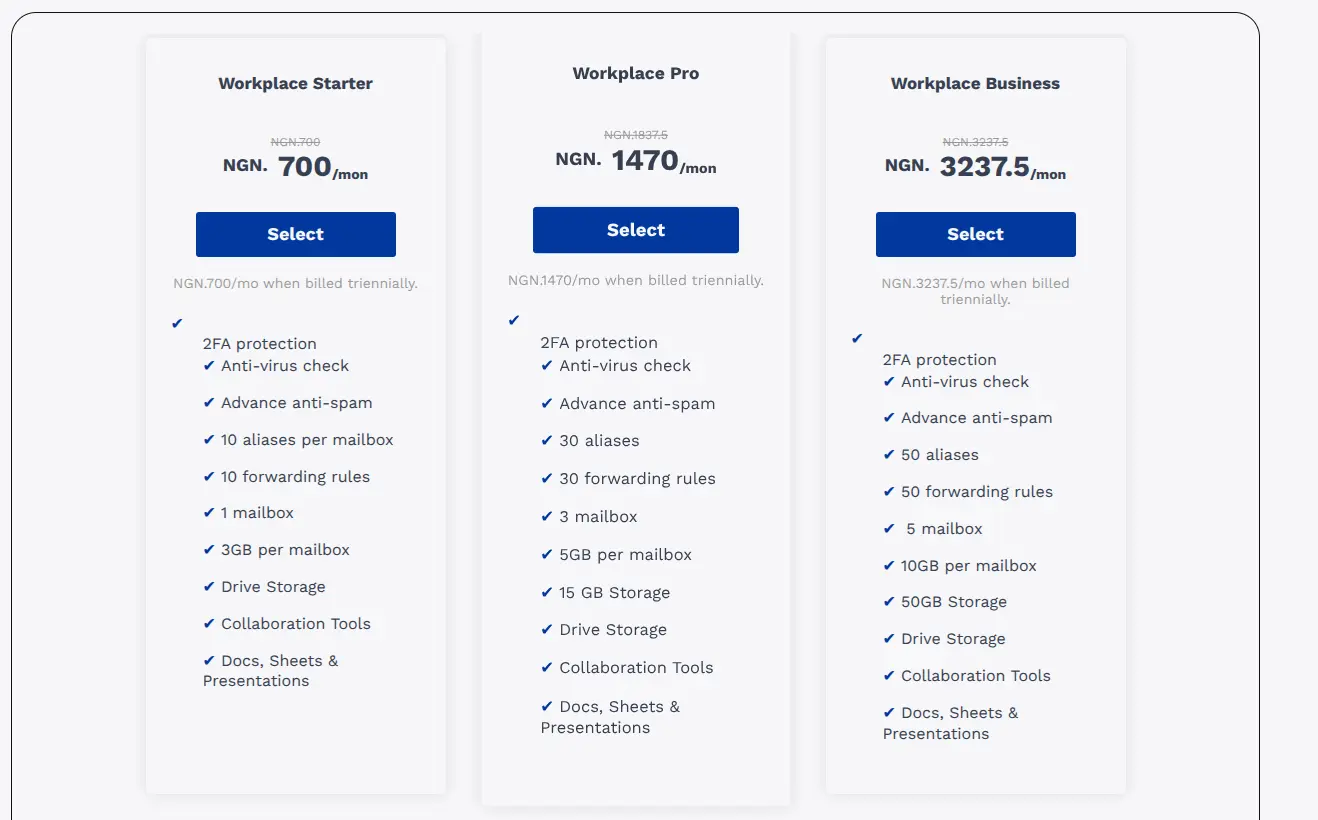
Their Workplace Starter plan is priced at ₦8,400 annually, which works out to roughly ₦700 per month. This fee covers one mailbox with 3GB of storage, ten email aliases, ten forwarding rules, and full anti-spam and anti-virus protection.
Truehost also offers triennial billing options that lower the effective monthly cost even further, making it exceptionally affordable for businesses that are willing to commit long-term.
The pricing scales logically; as your business grows, you can upgrade to plans that offer more mailboxes and significantly larger storage quotas, all while maintaining the same local currency stability.
Zoho Mail, on the other hand, is famous for its generous free forever tier, which allows up to five users with 5GB of storage each.
This is an incredible entry point for Nigerian micro-businesses, freelancers, and non-profits that need professional email but have zero budget for it.
However, the free plan comes with notable restrictions: you lose IMAP/POP3 access, meaning you cannot use desktop clients like Outlook or Thunderbird, and you miss out on advanced features like email hosting for multiple domains.
For paid plans, Zoho charges in US dollars, typically around $1 to $4 per user per month.
While Zoho has partnered with local Nigerian providers to facilitate naira billing, the underlying price remains tied to the dollar, exposing your business to exchange rate fluctuations.
When you factor in the cost of a separate website hosting package, which you would need to purchase elsewhere, the total expenditure for a Zoho-based setup can sometimes exceed what you would pay for Truehost’s all-inclusive bundle.
2) Control & Management
The level of administrative control you have over your email environment can dramatically affect your daily operations, especially if you manage multiple team members or complex forwarding rules.
Truehost places the full power of cPanel at your fingertips.
This is the industry-standard control panel used by web hosting professionals worldwide, and it gives you granular, root-level control over every aspect of your email configuration.
From the cPanel dashboard, you can instantly create or suspend email accounts, adjust disk space quotas per user, configure catch-all email addresses, set up complex email filters, and manage autoresponders.
You can also access your webmail through Roundcube or Horde, which are familiar interfaces for anyone who has used hosted email before.
This level of transparency means you are never locked into a proprietary system; you can export your data, change settings, and troubleshoot issues without having to go through a support ticket for basic administrative tasks.
Zoho Mail takes a different approach by offering its own proprietary web-based administrative console.
The interface is modern, intuitive, and visually clean, which appeals to users who find traditional cPanel interfaces intimidating or outdated.
Zoho’s admin panel allows you to manage users, configure domain settings, and apply security policies, but it does so within a more curated, walled-garden environment.
You cannot access the underlying server configurations or tweak low-level settings the way you can with cPanel.
While this streamlined approach reduces the risk of accidental misconfigurations, it also means you are dependent on Zoho’s interface for all administrative actions.
If you need to perform advanced email routing, script custom filters, or manage complex DNS records alongside your email, you will find Zoho’s system somewhat restrictive.
The trade-off here is between flexibility and simplicity; Truehost offers the former, while Zoho caters to users who prefer a guided, turnkey management experience.
3) Local Support & Infrastructure
For Nigerian businesses, the quality and responsiveness of customer support, as well as the physical location of servers, can have a direct impact on website loading speeds and issue resolution times.
Truehost is fundamentally a Nigerian company, and this local identity permeates every aspect of its service.
Their support team is based in Nigeria and operates on Nigerian time, meaning you can call, chat, or email them during regular business hours and expect a response from someone who understands the local context.
Furthermore, Truehost runs its infrastructure on servers specifically optimized for Nigerian traffic.
This means emails are routed through local data centers, resulting in faster delivery times and lower latency, which is particularly important if you are sending large attachments or running a high-volume email operation.
Zoho Mail, being a global giant, operates on a world-class infrastructure with data centers distributed across multiple continents, including the United States, Europe, and India.
While they do not have a dedicated data center in Nigeria, their global network is highly reliable and backed by a 99.9% uptime service level agreement. For support, Zoho primarily relies on its global ticketing system and online knowledge base.
Although they have made commendable efforts to establish a local presence in Nigeria, including enabling naira billing through authorized partners like PlanetWeb Solutions and Excellium, the core support team remains international.
This means you may experience delays due to time zone differences, and you might find yourself explaining local context to support agents who are unfamiliar with Nigerian internet service providers or domain registration quirks.
While Zoho’s global support is professional, it lacks the immediate, culturally-aware responsiveness that Truehost’s local team provides.
4) Ecosystem & Integrations
An email service does not exist in a vacuum; its value multiplies when it integrates seamlessly with other tools you use to run your business.
Truehost positions itself as a holistic, all-in-one solution for the Nigerian entrepreneur.
When you purchase email hosting from Truehost, you are not just buying a mailbox; you are buying into an ecosystem that includes domain registration, shared web hosting, VPS hosting, and SSL certificates, all managed from a single client dashboard.
This means you can buy your domain name, build your company website, and set up your professional email in one go without juggling multiple vendor accounts.
Truehost also includes basic productivity tools like online document editors, spreadsheets, and presentations, which are accessible directly from your webmail interface.
However, it is important to note that Truehost’s ecosystem is primarily infrastructure-focused; they are not a software-as-a-service company that builds CRM, accounting, or project management applications.
Zoho Mail is a completely different beast when it comes to ecosystem integration.
It is the gateway to the entire Zoho Workplace suite, which includes over 40 business applications. If you are a user of Zoho CRM, Zoho Books, Zoho Projects, or Zoho Analytics, your email becomes the central nervous system of your operations.
You can send quotes directly from your email, log client communications automatically into your CRM, and track project updates without ever leaving your inbox.
This deep integration saves countless hours of manual data entry and creates a unified workflow that is exceptionally hard to replicate with standalone email hosting. However, this ecosystem is only valuable if you actually use these applications.
For a simple service-based business that just needs email and a website, Zoho’s extensive ecosystem might be overkill.
Conversely, for a tech-savvy SaaS startup or a consultancy managing hundreds of client relationships, Zoho’s integration capabilities are a game-changer that Truehost simply cannot match.
5) Storage & Scalability
Your business will not stay the same size forever, and your email hosting plan needs to grow alongside it without forcing you into expensive, disruptive migrations.
Truehost offers a tiered storage system that is designed for the typical Nigerian business trajectory.
Their entry-level Workplace Starter plan gives you 3GB of storage for a single mailbox, which is sufficient for a solopreneur or a small business receiving moderate email traffic.
As you scale, you can move up to their Workplace Business plan, which provides 10 mailboxes with 10GB of storage each, and ultimately to the Workplace Enterprise plan, which offers 20 mailboxes with a generous 200GB of storage per mailbox.
This scalability is linear and straightforward; you can upgrade your plan with a few clicks, and because Truehost uses cPanel, you can also manually increase storage quotas for specific users if needed.
The platform comfortably supports growing teams without requiring you to switch to a completely different product.
Zoho Mail approaches scalability differently by focusing on per-user allocation rather than total account limits.
The free plan caps you at five users with 5GB each, which is fantastic for small teams but becomes restrictive as you add more employees.
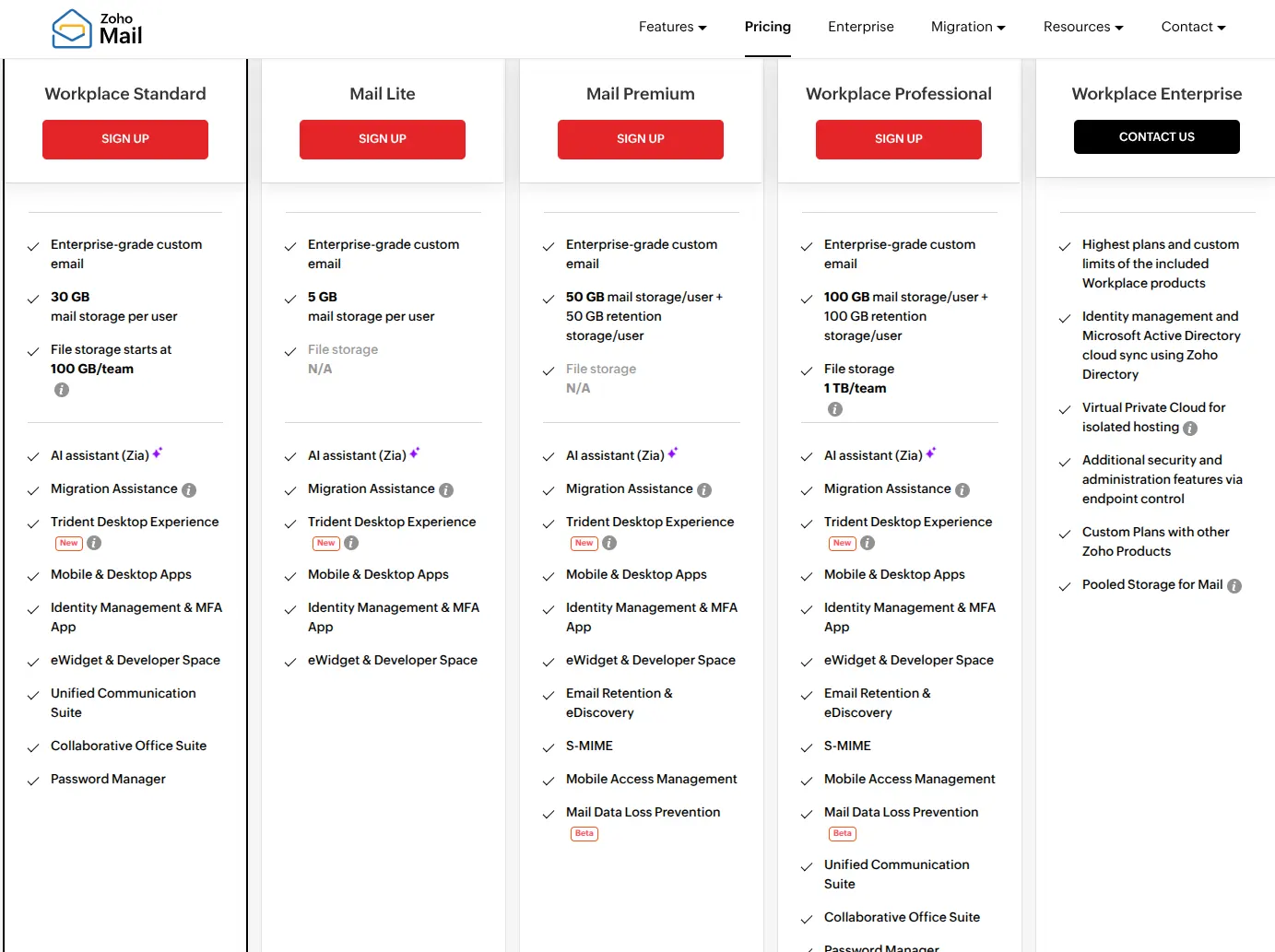
Their paid tiers, Mail Lite and Mail Premium, scale up to unlimited users, with storage increasing from 30GB per user on Mail Lite to 50GB per user on Mail Premium.
Beyond individual mailboxes, Zoho also offers the Workplace bundle, which adds collaborative file storage through Zoho WorkDrive, effectively giving your team a shared cloud drive.
This means your storage capacity is not just about how many emails you can keep, but also about how many documents, spreadsheets, and project files your team can collaboratively store and edit.
For a rapidly growing company that is heavily document-oriented, Zoho’s combined email and file storage offers a more integrated scaling experience, whereas Truehost’s scaling is more traditional, focusing purely on mailbox capacities.
6) Mobile & Desktop Access
In the modern business landscape, professionals rarely work exclusively from a single device.
The ability to access your corporate email seamlessly across smartphones, tablets, laptops, and desktops is non-negotiable.
Truehost supports IMAP and POP3 protocols on all of its paid plans, without exception.
This open-standard approach means you can configure your Truehost email account on virtually any email client available today, Microsoft Outlook, Apple Mail, Mozilla Thunderbird, or the default mail apps on Android and iOS.
You are not forced to use a specific web portal or proprietary mobile app.
This flexibility is particularly valuable for Nigerian businesses that have mixed IT environments; one employee might prefer Outlook on Windows, while another uses Apple Mail on a Mac, and both can access the same email account with full synchronization of folders, drafts, and sent items.
Furthermore, Truehost provides access to Roundcube webmail, which works perfectly in any modern browser if you need to check your email on the go without installing any software.
Zoho Mail takes a more controlled approach to device access.
On the free plan, IMAP and POP3 are entirely disabled, meaning you are forced to use Zoho’s own webmail interface or their dedicated mobile apps to read and send emails.
This limitation can be frustrating for users who are accustomed to the workflow of a desktop client.
However, once you upgrade to any paid plan, Zoho unlocks full IMAP/POP3 and ActiveSync support, allowing you to sync your emails, calendars, and contacts with any modern client or device.
Zoho’s proprietary mobile apps (available for iOS and Android) are polished and feature-rich, offering push notifications, calendar integration, and even offline access. The apps also provide a unified inbox if you manage multiple Zoho accounts.
Ultimately, while Truehost offers greater freedom and compatibility out of the box, Zoho’s proprietary apps offer a more curated mobile experience, albeit at the cost of locking free users out of third-party desktop clients.
7) Security
Email is the primary vector for cyberattacks, including phishing, malware distribution, and business email compromise scams.
Your hosting provider’s security posture is, therefore, a critical factor. Truehost incorporates multiple layers of security into its email hosting infrastructure.
Every plan comes with a free SSL certificate, which encrypts the connection between your browser and the mail server, protecting your login credentials and message content from interception.
Their servers run real-time anti-virus and anti-spam filters powered by industry-standard tools like SpamAssassin and ClamAV, which scan incoming and outgoing messages for malicious attachments and suspicious content.
Truehost also enforces two-factor authentication (2FA) at the cPanel level, adding an extra layer of protection against unauthorized access to your administrative dashboard.
However, because Truehost uses a shared hosting environment for its entry-level plans, the overall security profile is dependent on the server-level configurations managed by their system administrators.
Zoho Mail is built with a security-first architecture that benefits from Zoho’s massive scale and enterprise-grade investments.
All data is encrypted both in transit (using TLS) and at rest, meaning your stored emails are scrambled even if someone gains physical access to the servers.
Zoho offers robust spam filtering that utilizes machine learning to adapt to emerging threats, significantly reducing the amount of junk mail that reaches your inbox.
For paid users, Zoho provides advanced features like DMARC, DKIM, and SPF authentication reports, which are essential for preventing domain spoofing and improving email deliverability.
Additionally, Zoho supports multi-factor authentication and provides granular admin controls to enforce password policies across your organization.
Perhaps most importantly, Zoho adheres to strict global compliance standards, including GDPR, which gives you peace of mind regarding data privacy.
While both providers offer strong security, Zoho’s enterprise-grade infrastructure and continuous investment in threat intelligence provide a slight edge in protection against sophisticated attacks.
Which One Should You Choose?
Here’s the bottom line:
Choose Truehost if:
- You want to bundle website hosting + email in one place
- You prefer cPanel control over your email settings
- You value truly local support from a Nigerian team
- You want predictable naira pricing without forex fluctuations
- You need IMAP/POP3 access even on entry-level plans
- You’re running a Nigerian business that wants everything under one roof
Choose Zoho Mail if:
- You’re a startup or micro-business that needs free email (up to 5 users)
- You’re already using or plan to use Zoho’s ecosystem (CRM, Books, Projects)
- You prefer a modern, clean web interface
- You want a dedicated email solution without the complexity of cPanel
- You need advanced collaboration tools beyond just email
For most Nigerian businesses looking for the best value, Truehost is the smarter choice.
You get professional email hosting, full cPanel control, local naira pricing, servers optimized for Nigerian traffic, and support from a team that understands your market, all starting from as low as ₦700 per month.