 Domain NamesFind and register your ideal domain name instantly.
 Web HostingEasy-to-use hosting powered by cPanel — ideal for managing websites in Nigeria.
 Windows HostingRun .NET apps with Windows-optimized hosting
 Affiliate ProgramMake money promoting our services
 Reseller HostingMake money by reselling our hosting products under your own brand
 .COM Domains
 All DomainsExplore all supported tld domains in Nigeria
 WhoisFind out who owns any domain, as well as verify your registration details
 VPS Hosting in Nigeria
 Dedicated ServersReimagine your site speed with your own complete server
 AI Website BuilderDesign your site with drag-and-drop tools
 Online Store BuilderStart your online shop without code
 SSLs
SSLs Support PortalFind answers or get expert help
 Contact UsReach our team via chat or email
 BlogRead our extensive guides on web hosting and more
The short answer: .edu.ng is Nigeria’s restricted internet namespace for approved and accredited degree-awarding tertiary institutions in the country.
A university, polytechnic, college of education, or another qualifying institution may apply when its legal and regulatory status meets the NiRA policy.
It is not a general-purpose domain extension for every organisation that teaches. A tutorial centre, primary school, secondary school, education consultant, or course marketplace does not qualify simply because education forms part of its work.
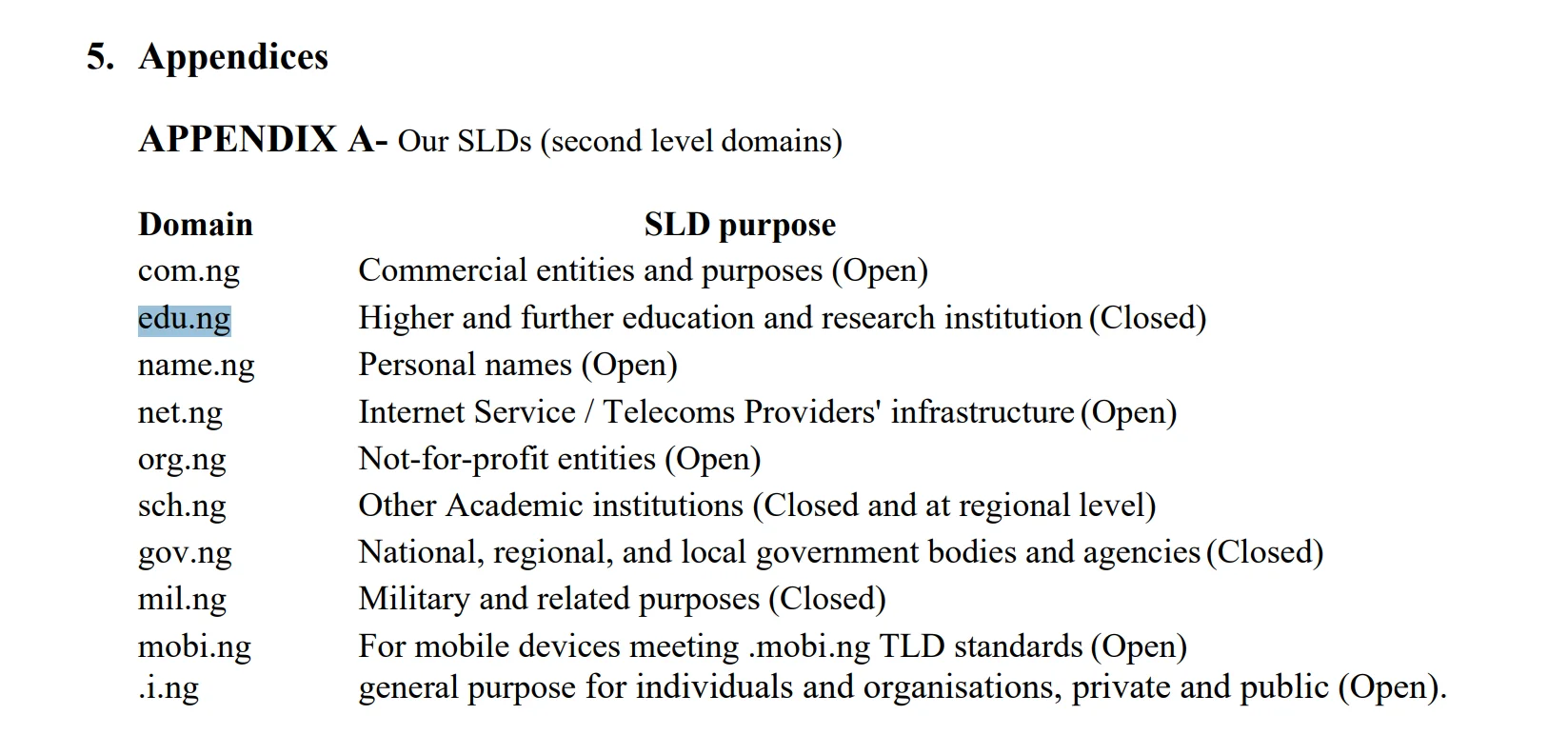
A .edu.ng domain, just like Kenya’s .ac.ke domain tells visitors that the website presents itself as a Nigerian tertiary institution, but it does not certify every claim, programme, or page on that website.
The short answer in one address
Consider a fictional institution called North River College. Its address could look like this:
northriver.edu.ng
The address has three meaningful parts:
Part | Meaning |
|---|---|
| The institution’s chosen and approved label |
| The restricted education category within |
| Nigeria’s country-code top-level domain |
Technically, northriver.edu.ng is a third-level domain. .ng is the top-level domain, edu.ng is the closed second-level namespace, and the institution registers the label beneath it.
What each part means
The institution name
NiRA expects the registered label to match the institution’s name or a recognisably similar version.
An applicant should therefore choose a short, defensible form of its official name instead of an unrelated marketing phrase.
Availability still counts. Another registrant may already hold the preferred label, and NiRA may reserve or restrict some names.
The institution should also check its authorisation and accreditation documents for consistent spelling before it applies.
The education namespace
The edu portion places the address in a controlled academic category. NiRA does not open this category to any buyer.
The applicant must establish its eligibility and submit supporting evidence through accredited registrars like Truehost.
That control gives the namespace meaning, but readers should not stretch it too far.
The address does not confirm that:
every programme currently holds accreditation,
every admissions claim is correct, or
every person using the institution’s email works there.
Nigeria’s country code
The .ng portion places the address in Nigeria’s national domain namespace. It gives an institution a clear Nigerian web identity and a stable home for public information and services.
Google treats a .ng domain as a country level tld, meaning it ties its ranking to Nigeria.
The extension alone does not guarantee a higher Google position in the country. Useful content, a technically sound website, strong institutional references, and good search optimisation still determine how such a site performs.
Who is .edu.ng designed for?
NiRA reserves .edu.ng for approved and accredited degree-awarding tertiary academic institutions.
The relevant route often involves one of these regulators:
the National Universities Commission for universities;
the National Board for Technical Education for institutions under its mandate;
the National Commission for Colleges of Education for colleges under its mandate; or
another authority that Nigerian law recognises for the institution concerned.
The word college in a business name does not settle eligibility. Regulatory recognition, legal establishment, award status, and the supporting documents settle it.
If your team still needs to answer “Do we qualify?”, use our requirements guide before placing an order.
.edu.ng vs .sch.ng
Nigeria separates degree-awarding tertiary institutions from primary, secondary, and other non-degree-awarding schools.
Question |
|
|
|---|---|---|
Main institution level | Degree-awarding tertiary | Primary, secondary, or other non-degree-awarding school |
Registration status | Closed | Closed |
Evidence route | Relevant tertiary regulator | Relevant government or accreditation authority |
Example |
|
|
A secondary school should not select .edu.ng because it sounds more prestigious. It should investigate .sch.ng.
An education company that does not operate as a qualifying school may need an open namespace such as com.ng or .ng, subject to its use and availability.
You can review other domain options before choosing.
What can an institution run under one domain?
A qualifying institution can use one approved .edu.ng domain as the root of its digital campus.
Common uses include:
the main public website;
admissions information and an application service;
student and staff portals;
a library catalogue or institutional repository;
research centres and journal pages;
official institutional email; and
faculty, department, and service subdomains.
For example, North River College could create:
admissions.northriver.edu.nglibrary.northriver.edu.ngengineering.northriver.edu.ng
This structure follows the policy logic: the qualifying institution owns the registered name, while its departments and units operate beneath it.
A faculty should not seek a separate full .edu.ng domain merely because it has its own website team.
The institution should set governance rules before creating many subdomains, as they can easily get out of hand, especially if no one is tasked to maintain them.
Name an owner for DNS, define who may request a subdomain, keep a current inventory, and remove abandoned services before they become security risks.
What the address does not guarantee
A restricted domain supports a credible institutional identity, but it cannot do the work of governance or website maintenance.
It does not guarantee programme accreditation. Students should still verify programmes through the institution and the relevant regulator.
It does not secure a website automatically. The ICT team still needs HTTPS, access controls, software updates, backups, monitoring, and an incident-response process.
It does not make all emails trustworthy. The institution should protect mail with SPF, DKIM, DMARC, strong authentication, and clear account-offboarding procedures.
It does not guarantee visibility in search. Search engines still need accessible pages, useful content, accurate titles, internal links, and consistent public references.
Finally, it does not replace accurate information. Admissions dates, fees, contact details, leadership pages, and regulatory statements need named owners and regular review.
Choose the institutional name carefully
The governing team should agree on the label before an administrator begins the order. Start with the legal name, common public name, and recognised abbreviation. Compare each option against the accreditation and establishment records.
A short label helps people type the address, but it should not become cryptic. A familiar abbreviation works when students, staff, and regulators already connect it to the institution. An internal project code rarely works as the institution’s permanent public identity.
Check four practical risks:
Ambiguity: Could the label reasonably point to another Nigerian institution?
Change: Does the label depend on a leader, programme, or location that may change?
Speech: Can a caller hear, spell, and repeat it without confusion?
Ownership: Has the institution approved the choice in writing?
Register the name through an institution-controlled account. Record why the team selected it and who authorised it.
That decision record helps a future administration distinguish the official domain from lookalikes, campaign domains, and old contractor registrations.
The institution can protect common variants when policy, availability, and budget allow, but it should select one canonical public address.
Redirect approved variants to the main domain instead of running several competing websites.
The name also needs a lifecycle. Put renewal, recovery, and registrar details in the institution’s asset register. Review its administrative and technical contacts at least once a year.
When the institution changes its legal name, consult the regulator and registrar before changing the public domain; a rushed replacement can break email, citations, bookmarks, and portal access.
How registration works
NiRA operates the registry for .ng. It uses a registry–registrar–registrant model: the institution acts as the registrant, an accredited registrar handles the application, and NiRA controls the namespace and policy.
You do not buy an eligible name directly from NiRA. You search and apply through a NiRA registrar.
The registrar collects the order and supporting documents, submits the restricted application, and communicates the approval outcome.
At Truehost, .edu.ng registration currently starts at ₦9,000.
Prepare your accreditation or approval evidence and an institutional authorisation letter before expecting activation.
Restricted applications require document review, so payment does not make the domain live instantly.
Choose your next guide
Unsure whether the institution qualifies? Read the requirements guide.
Ready to submit documents? Follow the registration steps.
Comparing providers and total cost? Use the registrar comparison.
Preparing an internal proposal? Review the seven benefits.