 Domain NamesFind and register your ideal domain name instantly.
 Web HostingEasy-to-use hosting powered by cPanel — ideal for managing websites in Nigeria.
 Windows HostingRun .NET apps with Windows-optimized hosting
 Affiliate ProgramMake money promoting our services
 Reseller HostingMake money by reselling our hosting products under your own brand
 .COM Domains
 All DomainsExplore all supported tld domains in Nigeria
 WhoisFind out who owns any domain, as well as verify your registration details
 VPS Hosting in Nigeria
 Dedicated ServersReimagine your site speed with your own complete server
 AI Website BuilderDesign your site with drag-and-drop tools
 Online Store BuilderStart your online shop without code
 Support PortalFind answers or get expert help
 Contact UsReach our team via chat or email
 BlogRead our extensive guides on web hosting and more
When you are starting out, it is easy to feel like your business is running you instead of the other way around.
You wake up to notifications from five different apps, to‑do lists scattered across WhatsApp, your notes app, and three spreadsheets, and there is that sinking feeling that something important is falling through the cracks.
Maybe a customer follow‑up, maybe an unpaid invoice, maybe a post that was supposed to go live yesterday.
The right tool stack puts you back in the driver’s seat.
It doesn’t just help you manage tasks; it gives you a clear view of your customers, your cash flow, and your marketing efforts without creating more noise.
Instead of juggling disconnected systems, you get one unified setup where everything talks to everything else.
This guide highlights the online business startup tools that help you stay focused, organised, and in control, right from day one.
And yes, it is only the best of the best tools for you!
Category 1: Website and Hosting
Every online business needs a place to call home.
Your website is where people find you, trust you, and ultimately buy from you.
But choosing the wrong foundation is like building a house on sand.
1) Truehost
Starting with a local provider makes everything simpler.
Truehost bundles web hosting, a website builder, and a domain name in one package.
Instead of paying separately for a domain registrar, a hosting plan, and a site builder, you get everything together, which saves money and eliminates the headache of managing three different accounts.
The website builder is AI-assisted, so no coding experience is required. A professional‑looking site can be up in an afternoon.
Truehost’s servers are positioned to serve Nigerian audiences, meaning fast load times for local visitors.
Something that is hard to achieve with overseas hosts that route traffic halfway around the world.
Billing is in naira, support is available on WhatsApp during Nigerian business hours, and the Starter plan begins at around ₦1,275 per month when billed triennially.
For a new entrepreneur testing the waters, it is one of the most affordable, locally‑friendly ways to get online.
2) WordPress
WordPress powers over 40% of the web.
It is open‑source, flexible, and supported by a massive ecosystem of themes and plugins.
For selling products, WooCommerce (the ecommerce plugin for WordPress) integrates with Nigerian payment gateways like Paystack and Flutterwave out of the box.
The software itself is free, but hosting and a domain are required.
The trade‑off is that WordPress needs ongoing maintenance like plugin updates, security checks, performance tweaks.
For founders comfortable spending a few hours a month on upkeep, it is one of the most powerful platforms available.
3) Wix
Wix is built for people who want to launch fast without touching code.
The drag‑and‑drop editor handles layout decisions, and everything, hosting, security, mobile optimisation, is included.
There is no need to install plugins or configure servers.
The free plan exists, but a premium plan (starting around $17-$159 per month) is required to connect a custom domain and remove Wix ads.
The main drawback is portability: Wix sites are harder to move elsewhere if business needs change.
Still, for a simple portfolio or small business site, it is a solid, low‑maintenance choice.
Category 2: Email Marketing
Social media may fail or algorithms change. I mean, look at the 2025 incident concerning TikTok in the United States.
However, your email list? That is yours forever.
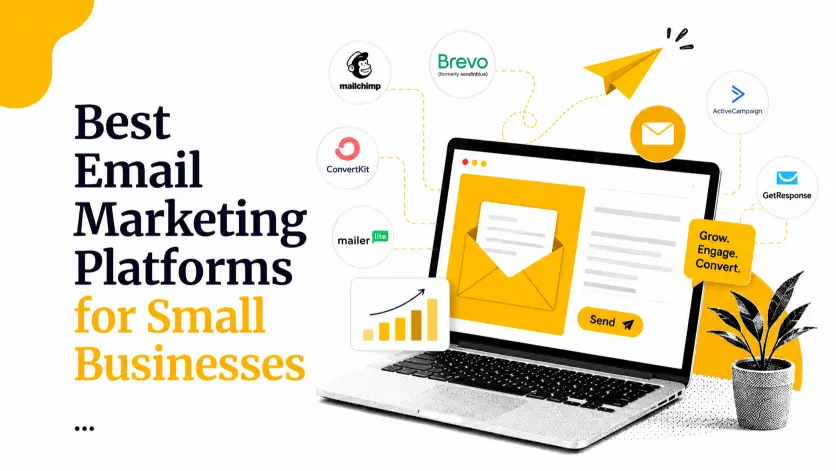
4) Mailchimp
Mailchimp’s free tier is genuinely useful for beginners.
Up to 2,000 contacts and 10,000 emails per month cost nothing, enough to build an initial audience and test whether email marketing works.
The interface is user‑friendly, with templates that make emails look professional without a designer.
Automation features let you set up welcome sequences, abandoned cart reminders, and follow‑ups based on subscriber behaviour.
As the list grows, paid plans start around $14 per month.
The free plan’s automation is basic, but it is more than enough to get started.
5) Brevo (formerly Sendinblue)
Brevo offers more automation on its free plan than Mailchimp.
The free tier allows unlimited contacts, capped at 300 emails per day, sufficient for most new businesses.
A standout feature is built‑in SMS marketing.
In Nigeria, SMS open rates remain high, and Brevo lets you combine email and SMS campaigns in one platform.
It also handles transactional emails (like order confirmations) without needing a separate tool.
The interface is clean, and pricing is transparent. For businesses planning to use SMS, this is a strong contender.
6) Kit ( ConvertKit)
Kit is designed specifically for creators, bloggers, YouTubers, podcasters, and authors.
If the business revolves around content and digital products, this tool is worth serious consideration.
The free plan covers up to 1,000 subscribers, generous for a niche‑focused platform.
Kit excels at landing pages and forms that are clean and convert well.
It also includes its own commerce feature, so ebooks, courses, and paid newsletters can be sold without a separate ecommerce setup.
The automation builder is visual and intuitive, making it easy to map out subscriber journeys.
Paid plans start around $33 per month, but many creators stay on the free plan for a long time.
Category 3: Analytics
You cannot improve what you do not measure. These tools tell you where your traffic comes from, what visitors do on your site, and where they drop off.
7) Google Analytics
Google Analytics (GA4) is the industry standard.
It is free, powerful, and essential for knowing where traffic comes from, what visitors do on the site, and where they drop off.
The setup has a learning curve, especially around event tracking and privacy configuration, but once it is running, it becomes the daily decision‑making tool.
Which pages drive the most traffic? Where are visitors located?
How long do they stay? That data turns guesswork into strategy.
8) Google PageSpeed Insights
Speed is a silent killer for online businesses.
Research shows that 53% of mobile visitors leave if a page takes longer than three seconds to load. Each second saved directly affects conversions.
PageSpeed Insights analyses a site and delivers specific, actionable recommendations: compress images, enable caching, reduce server response time.
It doesn’t fix issues automatically, but it tells exactly what is broken.
The tool is free and should be used before launch and periodically afterward.
9) Semrush
For businesses relying on organic traffic, Semrush is a powerful investment.
It is an all‑in‑one SEO toolkit covering keyword research, site audits, backlink tracking, and competitor analysis.
Users can see which keywords competitors rank for, identify content gaps, and track rankings over time.
The site audit feature crawls like a search engine and flags technical issues that could hurt visibility.
The Pro plan starts around $220 per month, with discounts for annual billing.
A limited free version exists, and a 7‑day free trial allows testing before committing.
Category 4: Social Media Management
Posting consistently is one of those things that sounds simple until you are actually doing it.
Social media management tools help you batch-create content and schedule it across platforms.
10) Buffer
Buffer keeps social media management manageable.
The free plan allows scheduling up to 10 posts per account, encouraging strategic sharing.
It connects Facebook, Instagram, Twitter, LinkedIn, and Pinterest from one dashboard.
The analytics show when an audience is most active, so posts can be scheduled for maximum engagement.
Paid plans start around $120 per year and add engagement tools and team collaboration.
For solopreneurs, the free version is often enough to maintain a consistent presence without daily manual posting.
11) Canva
Canva is the go‑to tool for creating visuals without hiring a designer. The free version includes thousands of templates, stock photos, and design elements.
Users can create Instagram posts, Facebook covers, YouTube thumbnails, and even simple animations.
The drag‑and‑drop interface requires no design experience.
Canva Pro (around $12.99 per month) adds background removal, brand kits, and resizing tools, but the free tier is sufficient for most early‑stage entrepreneurs.
Category 5: Finance and Payments
If you can’t track cash flow, you can’t grow. Period.
12) Stripe
Stripe handles online payments for businesses of all sizes, one‑time payments, subscriptions, and complex billing.
It integrates seamlessly with most ecommerce platforms, including Shopify, WooCommerce, and custom sites.
Setup is fast, fees are transparent (typically around 2.9% + fixed fee), and fraud protection is built in.
For Nigerian businesses, Stripe supports local payment methods and simplifies international transactions.
The per‑transaction fee matters for thin margins, but for businesses selling globally, it is hard to beat.
13) Paystack
Paystack is the Nigerian payment gateway that understands the local market.
It integrates with most ecommerce platforms and offers solutions for both online and in‑person payments via Paystack Terminal.
For businesses whose customers are primarily in Nigeria, Paystack is a natural choice.
It supports bank transfers, card payments, USSD, and mobile money, all the methods Nigerians use. Fees are competitive, and support is local.
The dashboard provides detailed reporting, so sales can be tracked without spreadsheets.
14) Wave
Wave offers a forever‑free accounting and invoicing plan.
Professional invoices can be created, payments accepted (via credit card or bank transfer), and expenses tracked without monthly fees.
Paid features, like payroll and advanced reporting, kick in as the business grows, but the free version covers the basics well.
The interface is clean and designed for small business owners without accounting backgrounds.
For startups needing to manage cash flow without extra subscription costs, Wave is a practical choice.
Category 6: Project Management and Collaboration
Chaos kills startups. These tools keep everyone on the same page.
15) Trello
Trello uses simple, visual Kanban boards to track tasks.
The interface is intuitive enough that teams actually use it. Cards can hold checklists, due dates, attachments, and assignments.
The free plan includes unlimited boards, so everything from product launches to client projects can be organised in one place.
Paid plans start around $12.50 per user per month and add custom fields and advanced automation. Many startups run on the free version for years.
16) Notion
Notion combines project management, knowledge base, meeting notes, and company wiki in one workspace.
Databases, collaborative documents, and even simple CRMs can be built within the platform.
The learning curve is steeper, there is a lot of flexibility, but once the structure is set, it’s difficult to switch away.
The free plan for individuals is generous, and team plans start around $10 per user per month.
For startups that want a single tool to manage internal operations, Notion is a popular choice.
17) Brosix
When Slack’s free limitations become painful, such as losing message history after 90 days, Brosix offers a private network.
File sharing has no limits, and setup takes about 10 minutes.
It provides a mini‑corporate infrastructure without the corporate price tag. Group chats, screen captures, and voice calls are included.
The free plan is limited to 10 users, ideal for a small startup. Paid plans add screen sharing and remote desktop control.
For teams tired of losing context across scattered WhatsApp groups, Brosix is worth considering.
Category 7: Customer Relationship Management (CRM)
Your customers are your most valuable asset.
A CRM helps you track interactions, manage follow-ups, and actually remember who’s who.
18) HubSpot CRM
HubSpot’s free CRM is surprisingly comprehensive.
It covers contact management, email tracking, deal pipeline visibility, and basic automation. Emails can be logged, follow‑ups scheduled, and lead stages tracked.
As the business grows, marketing, sales, and service hubs can be added, but many small businesses run on the free version for years.
The interface is clean, and the tool integrates with a wide range of other platforms.
HubSpot also provides extensive educational resources, so new users aren’t left figuring things out alone.
19) Zoho CRM
Zoho CRM is more affordable than Salesforce and includes built‑in automation and AI tools.
It suits solopreneurs and small sales teams who want to automate routine tasks without expensive add‑ons.
The free tier covers up to three users, enough for most startups.
Paid plans start around $29 per organization per month and add workflow automation, advanced analytics, and social media integration.
Zoho’s broader ecosystem (books, inventory, email) can be connected, making it a strong option for a unified business stack.
20) Pipedrive
Pipedrive is built around the sales pipeline.
If the business relies on moving leads through stages, from first contact to closed deal, this tool makes that process visual and simple.
The interface focuses on activities: tasks, calls, and next steps are clearly displayed.
It is less of a full‑scale CRM and more of a sales management tool, which is exactly what many startups need.
Pricing starts around $14 per user per month, with a 14‑day free trial.
For businesses where sales activity drives growth, Pipedrive keeps things organised without overwhelming users with unnecessary features.
How to Build a Stack That Actually Works Together
Before adding a new tool, three questions should be answered:
- Does it integrate with what is already in use? If not, it creates another silo.
- Can the business afford to maintain it? Every tool requires time to learn and manage.
- What problem is it solving? Tools should be added to address a specific pain point, not because a blog post said they were essential.
Actually, the Country Head, Zoho Nigeria, Mr. Kehinde Ogundare, said: “Businesses today require unified solutions to optimize value, maximize competitive advantages, and seize new market opportunities.”
Start with the fewest tools that cover core needs.
For most Nigerian service‑based businesses, that is a hosting/website platform (Truehost), a payment processor (Paystack or Stripe), and a communication system (WhatsApp Business, Google Workspace).
Master those first, then add more when a clear operational wall appears.
In Conclusion
Founders with the most sophisticated tech stacks sometimes fail.
Others with nothing but a WhatsApp group and a Paystack link succeed.
The difference isn’t the tools, it is the discipline to use them consistently and the clarity to know what problem each one solves.
The right tools make operations faster, reduce complexity instead of adding layers, and free up mental energy for what is actually important: serving customers, improving products, and building something that lasts.
Start small. Choose tools that work together. And remember: the goal isn’t to have the most tools, it is to have the right tools that actually help move forward.
Now go build something great.