 Domain NamesFind and register your ideal domain name instantly.
 Web HostingEasy-to-use hosting powered by cPanel — ideal for managing websites in Nigeria.
 Windows HostingRun .NET apps with Windows-optimized hosting
 Affiliate ProgramMake money promoting our services
 Reseller HostingMake money by reselling our hosting products under your own brand
 .COM Domains
 All DomainsExplore all supported tld domains in Nigeria
 WhoisFind out who owns any domain, as well as verify your registration details
 VPS Hosting
 Dedicated ServersReimagine your site speed with your own complete server
 AI Website BuilderDesign your site with drag-and-drop tools
 Online Store BuilderStart your online shop without code
 Support PortalFind answers or get expert help
 Contact UsReach our team via chat or email
 BlogRead our extensive guides on web hosting and more
The first big decision every OpenClaw user faces: do you host it locally on a machine in your home, or do you deploy it to a VPS (Virtual Private Server) in the cloud?
The short answer? Both can work.
But which one wins depends entirely on what you value more. Privacy and iMessage access. Or 99.9% uptime and professional-grade reliability.
Let’s break it down.
For most OpenClaw users, a VPS wins this comparison.
The exceptions are narrow. You need iMessage integration. Or your workflow has a hard data-privacy requirement.
In either case, local hosting is the better call.
Outside those cases, the deciding factor isn’t price or specs. It’s how much setup work you’re signing up for.
OpenClaw has to stay online continuously to do its job. So the hosting choice that wins is the one that doesn’t get in the way of that.
This is the openclaw vps vs local question. Not which is more powerful, but which one keeps working while you’re asleep.
Openclaw VPS vs Local Comparison Table
| Feature | OpenClaw VPS (Truehost) | Local (Home Server) |
|---|---|---|
| Uptime & Availability | Data-center grade, unaffected by grid collapse | Depends on your own power and internet |
| Monthly Cost | ₦14,000–₦63,000/mo, pre-configured | ~₦0/month after hardware payoff, plus inverter/UPS backup |
| Time to Live | Under 5 minutes, one-click deployment | Hours to days (install, expose to internet, secure) |
| Data Privacy | Data leaves your premises | Full data sovereignty |
| Messaging Platforms | WhatsApp, Telegram, Slack, Discord, Signal | Same, plus native iMessage on macOS hardware |
| Security Responsibility | You secure the OS; we secure infrastructure | You secure everything, including your home network |
| Scalability | Upgrade in a few clicks, no downtime | Limited by physical hardware |
| Setup Difficulty | Minimal, pre-configured | Moderate to hard (port forwarding, dynamic IPs, CGNAT) |
| Payment | Naira billing, no forex exposure | One-time hardware cost, often forex-exposed |
1) Uptime & Availability
Uptime means one thing. How often your OpenClaw agent is available and running.
A VPS built on redundant power and enterprise-grade connections can hit 99.9% uptime. Do the math, and that’s a maximum of roughly 8.7 hours of downtime a year.
Local hosting in Nigeria faces a tougher opponent: the national grid itself.
On January 23, 2026, Nigeria’s national grid recorded its first collapse of the year, with generation dropping from nearly 4,000 megawatts to zero within hours.
Just four days later, on January 27, the grid collapsed again, plunging millions of Nigerians into darkness for the second time that month.
It’s not just an outlier month. NERC’s October 2025 factsheet tells a similar story.
The country’s power plants had a Plant Availability Factor of just 40%. Out of 13,625MW of installed capacity, only 5,506MW was available for dispatch.
Even the power that was available wasn’t fully used, with just 78% of it reaching consumers.
Add unreliable home broadband from providers outside Lagos and Abuja, and you get a pattern. Not the occasional flicker. Full national instability.
Bottom line: VPS wins decisively here. Nigeria’s core problem isn’t a brief outage. It’s structural grid instability, and local hosting simply can’t route around that.
2) Monthly Cost vs. Upfront Hardware
Let’s talk numbers.
Truehost’s OpenClaw Starter plan runs ₦14,000 a month. You get 1 vCPU, 2GB RAM, 50GB NVMe SSD, and 4TB bandwidth, fully pre-configured with no setup fee.
If your workload grows, upgrading is simple:
- OpenClaw Starter: ₦14,000/mo, 1 vCPU, 2GB RAM, 50GB NVMe, 4TB bandwidth
- OpenClaw Pro: ₦28,000/mo, 2 vCPU, 4GB RAM, 100GB NVMe, 6TB bandwidth
- OpenClaw Business: ₦63,000/mo, 4 vCPU, 8GB RAM, 200GB NVMe, 8TB bandwidth
All plans are billed in Naira, with no hidden conversion fees. That’s a real advantage. International VPS providers bill in dollars, and card declines plus exchange-rate markups are common friction points for Nigerian users. You can also pay via Paystack, card, or bank transfer.
Now, local hosting.
A Raspberry Pi 5 can look cheap on paper. But once it lands in Nigeria, import duty and forex conversion push the price up.
Marketplace listings on Jiji show fully-kitted Pi 5 boards starting from roughly ₦85,000, and that’s before you add storage, casing, and cooling.
A Mac Mini costs more. Apple’s US pricing starts at $599 for the base M4 model. At current exchange rates hovering around ₦1,370–1,380 to the dollar, that’s already over ₦820,000 before Nigerian import duty and forex conversion are factored in.
Then there’s the part people forget: backup power. Surviving a full grid collapse isn’t a job for a small UPS. You need an inverter-and-battery setup, and that adds real money to your upfront local cost.
Bottom line: VPS wins on entry cost, forex predictability, and zero import hassle. Local still appeals if you want zero recurring fees. But once backup power is factored in, the true upfront cost is steeper than it first looks.
3) Data Privacy & Control
Every time OpenClaw runs, it generates something. Message logs. Automation history. Tool execution traces. API call records.
Where that data lives is very important.
On a VPS, your data leaves your premises. We at Truehost encrypt data and follow standard security practices. For most everyday automation, customer support bots, WhatsApp Business flows, sales workflows, that’s a reasonable trade-off.
Local hosting keeps everything on your own network. Nothing leaves.
That is more important for some businesses than others.
Nigeria’s data protection framework applies broadly to any organization that collects, processes, or stores personal data, including financial institutions handling sensitive financial information and healthcare organizations processing medical records.
It’s worth noting the framework itself has changed recently.
The older Nigeria Data Protection Regulation (NDPR) ceased to be the operating law in September 2025, replaced by the Nigeria Data Protection Act (NDPA) together with its implementation directive.
If you’re in legal services, healthcare, or fintech, this is the current rulebook to check against, not the old NDPR.
Bottom line: local wins for hard-requirement cases under the NDPA or similar regulation. VPS is the reasonable trade-off for everyone else.
4) Security Responsibilities
Split security into two layers. Infrastructure: the physical server, network, and data center. And application: the OS, firewall, and access controls.
On a VPS with us, we handle the infrastructure layer. Firewall rules. DDoS filtering. Automated snapshots. You only manage the OS and application layer.
Local hosting hands you both layers. The server. The home network. The router. Every port-forwarding rule.
One misconfigured port can expose your API keys. One missed router firmware update can become an open door.
Bottom line: VPS wins. Your responsibility shrinks to just the application layer, manageable even if you’re not deeply technical.
5) Messaging Platform Support
OpenClaw’s gateway connects to WhatsApp, Telegram, Slack, Discord, Signal, and iMessage.
Nearly all of these run fine on a Linux VPS. WhatsApp Business is very important here, since it’s the dominant channel for Nigerian SME commerce and customer support automation.
iMessage is the one exception, but not a hard one. It isn’t a clean VPS-native connection. Still, workarounds exist. A Mac Mini colo relay. BlueBubbles-style bridges. The Linq plugin on OpenClaw.
These add setup complexity. They also add a dependency on Apple hardware somewhere in the chain. But they mean iMessage doesn’t force you back to local.
Bottom line: a VPS handles full platform support, including iMessage through a bridge. Local only pulls ahead if you want iMessage running natively, with zero bridge in the chain.
6) Scalability
One agent handling one workflow runs fine on almost any hardware.
But agents multiply. Browser automation gets added. Multiple agents run in parallel. Workloads get heavier.
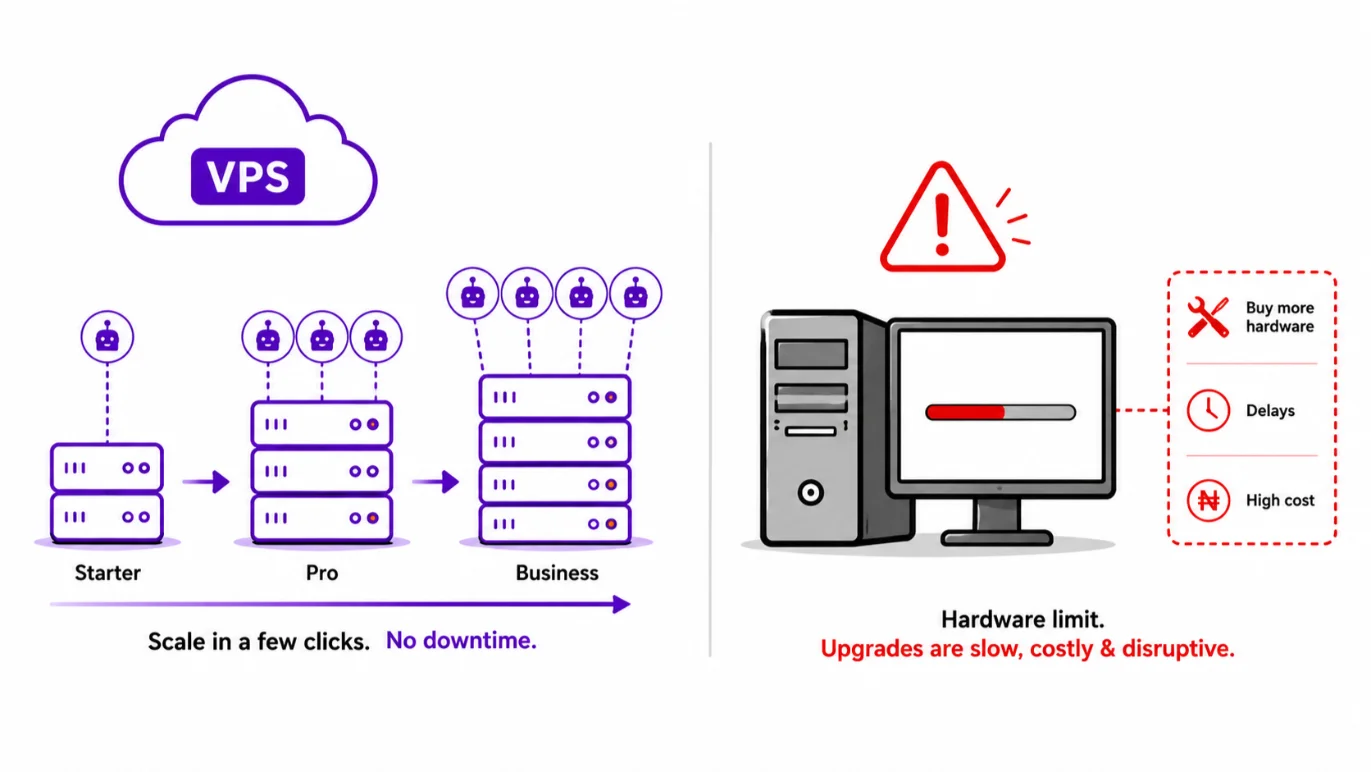
On a VPS, upgrading from Starter to Pro to Business takes a few clicks. No downtime. Budget roughly 2–3GB of RAM per additional agent, and on a VPS, that’s simply a plan upgrade.
Local hosting has a ceiling. Once you hit it, your options are limited: buy more hardware, or live with degraded performance.
And sourcing specific RAM modules or compatible parts in Nigeria isn’t always quick, given import delays and forex swings.
Bottom line: VPS wins easily. Scaling without disruption is one of the strongest practical arguments for cloud hosting as your OpenClaw use cases grow.
7) Setup Complexity
Getting OpenClaw running is one thing. Getting it reliably reachable from the internet is another.
Webhooks need to fire. Integrations need to connect. Responses need to happen in real time.
Local hosting means dealing with port forwarding, and that breaks the moment your ISP rotates your IP address.
Some Nigerian ISPs also use CGNAT (Carrier-Grade NAT), which can block inbound connections entirely.
Workarounds exist: Tailscale, tunnel services, a paid static IP add-on, but each one is another moving part.
On a VPS, pick a plan, pay via Paystack, card, or bank transfer, and your environment is live.
Truehost’s OpenClaw plans install everything automatically in under 45 seconds. No Docker install. No gateway configuration. No debugging a fresh Linux box on your own.
Want to see it for yourself? Deploy your OpenClaw VPS and check the setup time.
Bottom line: VPS wins clearly on setup complexity, and a pre-configured plan widens that lead even further.
8) Backup & Disaster Recovery
The real question isn’t just ‘does it stay online.’ It’s ‘if something breaks, how fast and how completely can you get back running? ‘
On a Truehost VPS, automated daily backups are already part of the setup, the same infrastructure-layer protection covered in Section 4. If something goes wrong, restoring to a prior state is a quick process, not a project.
Local hosting puts backup responsibility entirely on you. External drive or NAS backups.
No automated snapshotting unless you configure it yourself. And restore time depends on hardware availability, which isn’t instant to source in Nigeria.
There’s also a Nigeria-specific angle worth pairing with Section 1’s grid-collapse framing. A local server surviving a power event is only half the resilience story.
Fire, theft, flooding, or a power surge frying your hardware can still mean total data loss without an off-site copy.
Bottom line: VPS wins on recovery speed, with backups baked in by default. Local backup is possible, but it’s one more thing you have to build and maintain yourself, on top of the setup burden from Section 7.
When to Choose an OpenClaw VPS
- You need consistent uptime for business automation, customer-facing agents, or scheduled workflows
- You want predictable Naira pricing starting at ₦14,000/month with zero setup fee
- Your messaging platforms are WhatsApp, Telegram, or Slack, all fully supported
- You anticipate scaling to more agents or heavier workloads
- You’re dealing with grid instability or generator dependency at home, and want that out of the equation entirely
When to Choose Local
- iMessage is your primary communication platform, and you want it running natively without a bridge or relay in the chain
- Maximum data privacy is a hard requirement under the NDPA or similar regulations, legal work, health data, or other sensitive personal workflows
- You already own suitable hardware (Mac Mini, Raspberry Pi 5, an always-on spare PC)
- You’re comfortable managing your own network security, port routing, and uptime
Which One Wins?
For most OpenClaw users in Nigeria, a VPS wins.
Anchor that on the numbers. Two national grid collapses within four days in January 2026 alone, on top of NERC data showing only 40% plant availability as of October 2025. That’s not a rare edge case. That’s a structural risk to anything you need running around the clock.
The exceptions stay narrow. iMessage-dependent workflows. NDPA-driven hard privacy requirements. Outside those two cases, local hosting is a niche choice, one for privacy-sensitive use cases, iMessage users, and people who already own the hardware and are comfortable managing it.
For everyone else, the VPS is the practical choice.
We at Truehost offer pre-configured OpenClaw VPS plans starting from ₦14,000/month (OpenClaw Starter), scaling up to ₦28,000/month (Pro) and ₦63,000/month (Business) for heavier workloads.
All plans come with zero setup fee, automated installation, and dedicated support. Pay via Paystack, card, or bank transfer. Your server is live in minutes.
Openclaw VPS vs Local FAQs
Is OpenClaw VPS hosting better than running it locally in Nigeria?
For most users, yes. A VPS gives you data-center-grade uptime that local hosting can’t match against Nigeria’s ongoing grid instability. Local only wins for iMessage-native workflows or hard data-privacy requirements.
How much does OpenClaw VPS hosting cost in Nigeria?
Plans with us start at ₦14,000/month for Starter (1 vCPU, 2GB RAM), rising to ₦28,000/month for Pro and ₦63,000/month for Business. All are billed in Naira, with no forex exposure.
Does OpenClaw work with WhatsApp in Nigeria?
Yes. WhatsApp, including WhatsApp Business, runs natively on an OpenClaw VPS, alongside Telegram, Slack, Discord, and Signal.
Why can’t I use iMessage with an OpenClaw VPS?
iMessage isn’t a native cloud connection, since it’s tied to Apple hardware. You can still reach it through a bridge or relay setup, like a Mac Mini colo relay or the Linq plugin, but it adds a layer of complexity that local, native macOS hosting avoids.
Is my data safe on a Truehost OpenClaw VPS?
We secure the infrastructure layer with custom firewalls, DDoS protection, and automated daily backups. You manage your OS and application-level access. For most business automation use cases, this is a solid, standard level of protection.
How do I pay for OpenClaw hosting in Nigeria?
Through Paystack, card, or bank transfer, all in Naira. No dollar billing, no conversion fees, no surprises on your statement.