 DomainsFind and register your ideal domain name instantly.
 Web HostingEasy-to-use hosting powered by cPanel — ideal for managing websites in Nigeria.
 Windows HostingRun .NET apps with Windows-optimized hosting
 Affiliate ProgramMake money promoting our services
 Reseller HostingMake money by reselling our hosting products under your own brand
 .COM Domains
 All DomainsExplore all supported tld domains in Nigeria
 WhoisFind out who owns any domain, as well as verify your registration details
 Dedicated ServersReimagine your site speed with your own complete server
 AI Website BuilderDesign your site with drag-and-drop tools
 Online Shop BuilderStart your online shop without code
 Support PortalFind answers or get expert help
 Contact UsReach our team via chat or email
 BlogRead our extensive guides on web hosting and more
HostAfrica has grown into one of the more recognizable hosting names on the continent, expanding into Nigeria in 2021 and absorbing GO54, formerly WhoGoHost, in early 2026.
That consolidation is exactly why more Nigerian startups are searching for alternatives right now, fewer independent options, and less certainty about what pricing and support look like after an acquisition.
In this guide you’ll find what the top 15 Host Africa business email provider alternatives are genuinely good at, what to watch out for, and who it fits, starting with the option built specifically for Nigeria.
What Is Important When You’re Choosing
Before the list, here’s the short version of what to weigh against HostAfrica.
- Billing currency. Naira billing avoids exchange rate exposure and card declines that dollar-billed providers can trigger.
- Local support. A support team that understands the Nigerian market answers faster than one routed through a different time zone.
- Storage and mailbox limits. Check per-mailbox storage, not just the headline number, since some providers split it unevenly.
- Security basics. Spam filtering, virus protection, and two-factor authentication should come standard, not as a paid add-on.
- Renewal pricing. The advertised rate is rarely the renewal rate. Confirm what you’ll actually pay after the first term.
- Migration support. Moving away from HostAfrica should not cost extra or become its own project.
Quick Comparison
| Alternative | Starting Price | 1-Click Setup | Best For |
| Truehost | $0.51/mo | Yes | Naira billing and local support, direct HostAfrica swap |
| Google Workspace | $7/user/mo | Yes | Teams already living in Gmail, Docs, and Meet |
| Microsoft 365 | $7/user/mo | Yes | Teams already working in Word, Excel, and Teams |
| Zoho Workplace | $3/user/mo | Yes | Budget-conscious startups wanting a light suite |
| Titan Email | Partner-set | Varies | Sales-heavy, client-facing startups |
| Hostinger | $4.49/mo | Yes | Beginners wanting AI-assisted troubleshooting |
| GoDaddy | $5.99/mo | Yes | A recognizable global brand as you scale |
| Namecheap | $0.91/mo | No | Domains already registered with Namecheap |
| Bluehost | $1.99/mo | Yes | Bundling email with WordPress hosting |
| Qservers | Bundled | No | Local Nigerian support bundled with hosting |
| Neo | Free | Yes | Testing a branded address before spending |
| Proton Mail for Business | $6.99/user/mo | No | Startups handling sensitive client data |
| Fastmail | $3/user/mo | No | A fast, focused inbox with nothing bundled |
| IONOS | $1/mo intro | No | The lowest possible starting number |
| Rackspace | $3.99/user/mo | No | Startups that have outgrown a bare-bones setup |
1) Truehost

Truehost was built specifically for Nigerian business owners who are tired of international providers that don’t understand the local market, naira cards getting declined, support in a different time zone, and spam filtering that doesn’t actually work.
It’s the most direct like-for-like alternative to HostAfrica for a Nigerian startup, minus the continent-wide overhead built into the price.
Pricing: From $0.51 a month, with NVMe storage, free SSL, daily backups, and cPanel included as Standard.
Features
- Pay in naira with no card decline surprises. billing goes through the way a Nigerian startup actually pays, without foreign transaction friction
- Get help from people who understand the market. 24/7 local support answers without routing through a different time zone
- Avoid the renewal jump. pricing stays close to what you signed up for, instead of climbing after the intro term
- Migrate away from HostAfrica for free. Moving your mailboxes over doesn’t cost extra or become its own project
- Manage everything from one familiar panel. cPanel access with daily backups and free SSL included as Standard, not sold separately
Pros
- Lowest naira-friendly starting cost on this entire list
- Local support team that understands the Nigerian market
- Transparent renewal pricing with no surprise jump later
- Free migration support if you’re moving away from HostAfrica
Cons
- No bundled collaboration suite, so a startup wanting shared docs or chat needs a separate tool
Best For: A Nigerian startup that wants the most direct, locally-built alternative to HostAfrica, with naira billing and local support built in.
2) Google Workspace

Google Workspace pairs Gmail with a full productivity suite, Docs, Drive, Meet, and Calendar, all tied to your custom domain.
For a startup that collaborates constantly, everything lives in one login instead of a separate stack for docs, video calls, and storage.
Pricing: From $7 per user a month, billed annually for the best rate, with a limited free trial available.
Features
- Run your inbox on your own domain. Gmail’s search, filters, and spam detection work against your business address, not a personal account
- Collaborate without leaving the browser. Docs, Sheets, Meet, and Chat share files and permissions natively
- Store files without a separate tool. pooled storage on the entry tier scales up to 5TB per user on higher plans
- Manage every user from one place. The admin console controls accounts, devices, and apps across the whole team
Pros
- Everything a collaborative team needs in one connected suite
- Familiar interface, most new hires already know
- Strong spam filtering and account security by default
Cons
- The best-value rate requires a one-year commitment
- Shared storage on the entry tier fills up faster than expected
Best For: A startup that already lives in Gmail, Docs, and Meet and wants everything under one login.
3) Microsoft 365
Microsoft 365 bundles Outlook email with Word, Excel, PowerPoint, Teams, and OneDrive, making it the natural fit for a startup already built around Office apps.
For a team with a corporate background, meetings, files, and email all connect through the same login.
Pricing: From $7 per user a month for Business Basic, rising to $32 per user a month for Business Premium with Copilot
Features
- Access a full 100GB mailbox anywhere. available on web and mobile on every plan, with desktop apps unlocked from Business Standard
- Run meetings without a separate tool. Teams integrates directly with Outlook calendar and OneDrive on every plan
- Keep files synced across every device. 1TB of OneDrive storage per user comes included
- Speed up daily tasks with AI. Copilot works inside Word, Excel, PowerPoint, and Outlook on higher tiers
Pros
- One connected system for meetings, files, and email
- Desktop Office apps included from Business Standard up
- Strong device security options on Business Premium
Cons
- Per-user pricing means every new hire adds a full subscription
- The interface has a real learning curve without dedicated IT support
Best For: A startup already working in Word, Excel, and Teams that wants everything bundled into one subscription.
4) Zoho Workplace
Zoho Workplace bundles ad-free business email with a light office suite, Writer, Sheet, Show, and the Cliq team chat tool, priced well below Google or Microsoft’s equivalents.
It connects natively to Zoho CRM and Projects if your sales team already runs on Zoho elsewhere.
Pricing: From $3 per user a month for Workplace Standard, $6 per user a month for Workplace Professional
Features
- Get an office suite without the premium price tag. Writer, Sheet, Show, and Cliq chat come included on Workplace plans, not sold separately
- Collaborate directly inside the inbox. Comment on emails and tag teammates instead of forwarding threads back and forth
- Connect to tools you already use. native integration with Zoho CRM, Projects, and Desk saves setup time
- Stay connected from any device. native iOS, Android, and desktop apps keep the team in sync
Pros
- Email plus office apps without Google or Microsoft’s price tag
- Native integration with the wider Zoho ecosystem
- Ad-free inbox with encryption options included
Cons
- The plan lineup is easy to overpay on without comparing tiers carefully
- Some tiers require annual billing paid upfront
Best For: A budget-conscious startup that wants a light collaboration suite without Google or Microsoft’s price.
5) Titan Email
Titan Email is a business email platform sold through web hosting and domain registrar partners rather than directly.
It’s built for freelancers and startup sales teams who live in client-facing email, with a built-in sales toolkit most providers charge extra for.
Pricing: Set entirely by the partner registrar or host selling it, so check that partner’s pricing page directly.
Features
- Know the moment a client opens your email. Read receipts tell you exactly when a message has been seen
- Never lose track of a follow-up. Set a reminder if a specific email doesn’t get a reply within a set period
- Send faster with saved formats. Email templates cover proposals, quotes, and thank-you notes
- Coordinate meetings across platforms. Shareable calendars work across Gmail, Outlook, or Apple Mail
Pros
- Purpose-built tracking and follow-up tools for client-facing email
- Built-in templates save time on repetitive sends
- Integrates with your existing domain or hosting partner
Cons
- Pricing and features depend entirely on whichever partner host sells it
- No standalone productivity suite beyond email tools
Best For: A sales-heavy, client-facing startup that wants tracking and reminders built into everyday email.
6) Hostinger
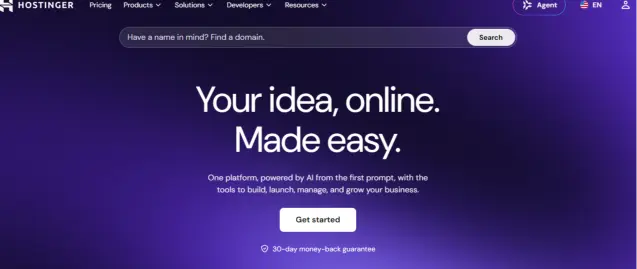
Hostinger offers business email bundled with hosting, backed by Kodee, its built-in AI assistant that suggests fixes the moment something breaks.
Entry specs run strong for the price, useful for a founder without a dedicated IT person.
Pricing: From $4.49 a month for the entry business email plan
Features
- Get unstuck without a forum search. Kodee suggests fixing the moment something goes wrong
- Start with real headroom. Storage and mailbox limits on the entry tier beat most competitors at a similar price
- Keep backups running automatically. Weekly backups are included by default
Pros
- Beginner-friendly troubleshooting built into the dashboard
- Strong storage and mailbox specs for the price point
- Weekly backups included without an add-on fee
Cons
- Billed in dollars, so exchange rate exposure applies at checkout
- Support quality varies by region compared to a Nigeria-first provider
Best For: A founder who wants hand-holding when something breaks and doesn’t mind paying in dollars.
7) GoDaddy
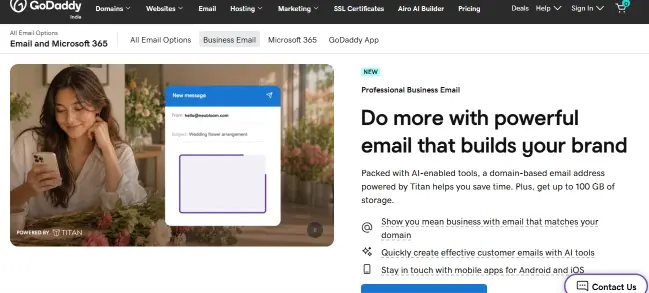
GoDaddy pairs email hosting with AI-assisted setup tools and a brand most clients already recognize.
That recognition matters once a startup starts pitching bigger, more risk-averse customers who want a familiar name behind the vendor.
Pricing: From $5.99 a month for the entry business email plan
Features
- Set up faster with AI assistance. Guided tools speed up domain and mailbox configuration
- Lean on a name clients already trust. GoDaddy’s brand recognition can smooth conversations with larger, more cautious customers
- Manage everything from one dashboard. domains, hosting, and email sit under a single account
Pros
- Globally recognized name that adds credibility with bigger clients
- AI-assisted setup tools speed up onboarding
- Broad range of bundled services beyond email
Cons
- Renewal pricing tends to climb noticeably after the first term
- Upselling during checkout is more aggressive than most alternatives here
Best For: A startup that wants a recognizable global name behind its email as it starts pitching bigger clients.
8) Namecheap
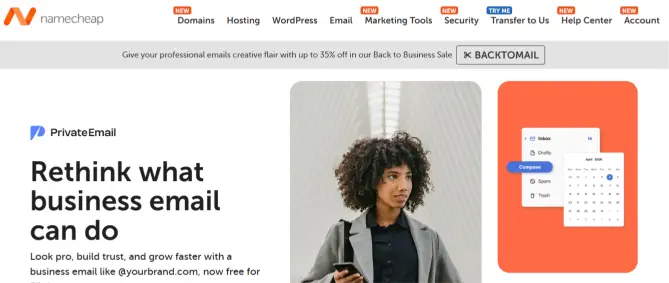
Namecheap’s Private Email product is one of the cheapest ways to get a branded inbox, especially convenient if you already manage your domain through their dashboard.
It keeps things simple rather than trying to be a full collaboration suite.
Pricing: From $0.91 a month for the entry Private Email plan
Features
- Manage the domain and email together. No need to juggle a separate account if your domain is already with Namecheap
- Start at one of the lowest prices around. Entry pricing undercuts most dedicated email providers on this list
- Get spam and virus filtering as Standard. Basic protections come included, not as a paid extra
Pros
- Keep domain and email management in the same account
- One of the lowest starting prices on this list
- Straightforward setup with no unnecessary extras
Cons
- Support and feature depth trail more email-focused providers
- No local Nigerian support or naira billing
Best For: A startup whose domain is already registered with Namecheap and wants the cheapest way to add email.
9) Bluehost

Bluehost is a well-known hosting name that pairs easily with WordPress hosting, useful for a startup building its site and email setup at the same time.
Email comes bundled into hosting plans rather than sold as a fully separate product.
Pricing: From $1.99 a month when bundled with a hosting plan
Features
- Launch your site and email together. No need to juggle two separate providers during setup
- Follow well-documented setup guides. Bluehost’s WordPress-specific documentation is thorough and easy to follow
- Manage everything from cPanel. email accounts, domains, and hosting sit under one familiar panel
Pros
- Set up site and branded email together without juggling providers
- Well-documented for WordPress-specific setups
- Bundled pricing can undercut buying hosting and email separately
Cons
- Entry pricing rises noticeably at renewal
- Billed in dollars, with no naira payment option
Best For: A startup bundling email with WordPress hosting rather than buying either separately.
10) Qservers
Qservers bundles email into affordable shared hosting plans, with a local Nigerian support team that users describe as responsive.
It doesn’t advertise standalone email plans as prominently as more dedicated competitors on this list.
Pricing: Bundled into shared hosting plans, with pricing varying by hosting tier
Features
- Get email included in hosting you might already need. No separate purchase required if you’re already hosting a website
- Reach a local support team. Nigerian users report quick, responsive support
- Keep costs predictable. Bundled pricing avoids paying for hosting and email as two separate line items
Pros
- Email included in a hosting plan you might already need
- Local support team with a reputation for quick responses
- Reasonable pricing for bundled hosting and email
Cons
- Standalone email-only plans aren’t a strong focus
- Fewer published details on email-specific features and limits
Best For: A startup that wants local Nigerian support with email already bundled into a hosting plan.
11) Neo
Neo offers a genuinely free way to get a professional-looking address running in minutes, with a simple setup built for non-technical founders.
You don’t own the domain outright, which is important once you’re ready to commit long-term.
Pricing: Free tier available, with paid plans starting around $1.99 a month for more storage and IMAP access
Features
- Get a branded address without paying anything. The free tier is enough for a side hustle or early-stage test
- Set up in minutes, not hours. The interface is built for founders with no technical background
- Add a basic website alongside email. A simple one-page website builder comes included
Pros
- Test a branded email for free before paying for anything
- Setup takes minutes, built for non-technical founders
- Includes basic AI writing tools for email
Cons
- You don’t own the domain, so it’s a starting point, not a permanent home
- Losing access if Neo changes its free offering means losing that address
Best For: A founder who wants to test a branded email for free before committing to a fully-owned domain.
12) Proton Mail for Business
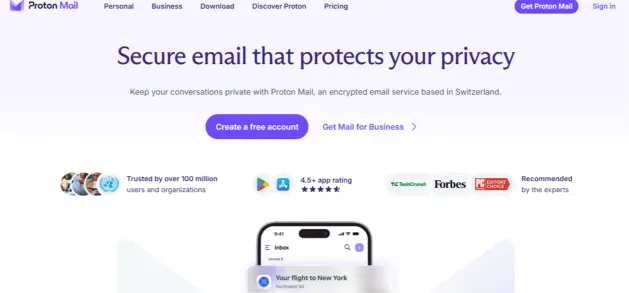
Proton Mail for Business provides end-to-end encrypted email under Swiss privacy law, useful for a startup in legal, health, or fintech where confidentiality is part of the pitch.
Proton cannot read the content of encrypted messages, and neither can anyone intercepting them in transit.
Pricing: From $6.99 per user a month for Mail Essentials, up to $19.99 per user a month for Workspace Premium
Features
- Send email encrypted by default. Messages between Proton users are encrypted before they leave the device
- Protect recipients outside Proton, too. send a password-protected message to anyone, even outside the platform
- Block tracking automatically. Tracking pixels in incoming emails are blocked by default
- Access encrypted storage and documents. included even on the entry plan, with video meetings on Workspace tiers
Pros
- Encryption is the default, not an extra step someone has to remember
- Automatic tracker blocking protects privacy on any network
- Strong fit for regulated industries handling confidential data
Cons
- No ongoing free tier, only a 14-day trial on Workspace plans
- Requires Proton Bridge to use with Outlook or Apple Mail
Best For: A startup in legal, health, or fintech that needs encryption built in, not bolted on.
13) Fastmail
Fastmail is an independent, ad-free email provider that has run its own infrastructure since 1999, built around a fast inbox with strong search.
It offers a focused alternative to the bundled complexity of a full productivity suite.
Pricing: From $3 per user a month for Standard, $9 per user a month for Professional
Features
- Search and manage email fast. The inbox is built for speed, not weighed down by bundled apps
- Work without a connection. Offline support lets you read, draft, and search email without internet, syncing once you’re back online
- Coordinate with shared calendars. Shared calendars and a company address book come with every plan
- Reach a real person when needed. 24/7 human support, rare at this price point
Pros
- Fast, reliable inbox without paying for tools you’ll never open
- Offline support and real human customer service
- Custom business addresses on every paid plan
Cons
- No document collaboration or video conferencing bundled in
- No free tier, only a 30-day trial
Best For: A founder who wants a fast, focused inbox and nothing else bundled in.
14) IONOS
IONOS wins on price alone, with introductory plans from around $1 a month.
Full root access, SSD storage, and DDoS protection come included even at that entry tier.
Pricing: From around $1 a month on the introductory plan
Features
- Start for next to nothing. Introductory pricing undercuts nearly every other provider on this list
- Get real infrastructure at that price. SSD storage and DDoS protection come Standard, even on the cheapest tier
- Access full root control. included from day one rather than gated behind a higher tier
Pros
- Lowest entry price on this entire list
- Full root access included even at the entry tier
- Real infrastructure, not a stripped-down trial product
Cons
- The renewal rate climbs well past that intro price
- No Nigeria-specific support or setup guidance
Best For: A tech-confident founder who only cares about the lowest possible starting number.
15) Rackspace
Rackspace offers hosted Exchange with enterprise-grade support, a natural next step for a startup that has grown past its early-stage email needs.
It’s built more for structure and scale than for a founder just getting started.
Pricing: From $3.99 per user a month for hosted Exchange
Features
- Run a full Exchange environment. useful for more complex team structures than a basic inbox setup
- Get enterprise-grade support. a level of structure most startup-focused providers don’t offer
- Scale mailboxes as the team grows. built to handle a headcount well beyond an early-stage team
Pros
- Enterprise-grade support once you outgrow a startup setup
- Full Exchange feature set for more complex team structures
- Proven track record with larger organizations
Cons
- Costs more than any Nigerian-first alternative on this list
- Overkill for an early-stage startup with a handful of mailboxes
Best For: A startup that has outgrown a bare-bones setup and wants an enterprise-grade structure.
Grab Your Business Email Now
If you want the fastest, most direct swap for HostAfrica with naira billing and local support, Truehost gets you there without the continent-wide overhead built into the price.
If your startup genuinely needs a collaboration suite, Google Workspace or Microsoft 365 justifies its higher price.
If you handle sensitive client data, Proton Mail for Business covers a gap that none of the mainstream options do by default.
And if you want to test a branded address before spending anything, Neo is the lowest-risk starting point.
Whichever you pick, match the plan to your startup’s actual stage, not just its budget.
That’s the decision that saves you money either way, and it’s the only one left once you’ve read this far.