 Domain NamesFind and register your ideal domain name instantly.
 Web HostingEasy-to-use hosting powered by cPanel — ideal for managing websites in Nigeria.
 Windows HostingRun .NET apps with Windows-optimized hosting
 Affiliate ProgramMake money promoting our services
 Reseller HostingMake money by reselling our hosting products under your own brand
 .COM Domains
 All DomainsExplore all supported tld domains in Nigeria
 WhoisFind out who owns any domain, as well as verify your registration details
 VPS Hosting
 Dedicated ServersReimagine your site speed with your own complete server
 AI Website BuilderDesign your site with drag-and-drop tools
 Online Store BuilderStart your online shop without code
 Support PortalFind answers or get expert help
 Contact UsReach our team via chat or email
 BlogRead our extensive guides on web hosting and more
Is n8n open source? Short answer: not technically. But for almost everyone who uses it, it behaves like it is.
That distinction confuses a lot of people.
Here’s why. n8n runs on the Sustainable Use License, a ‘fair-code’ license. It carries one real restriction: you can’t take n8n and resell it as your own hosted automation product.
The Open Source Initiative (OSI) has a strict rule. A license can’t call itself ‘open source’ if it restricts how you use the software.
n8n’s license does restrict one specific use. So n8n doesn’t call itself open source. n8n says this plainly in its own documentation.
This isn’t a marketing trick. It isn’t a gray area either.
It’s a deliberate, disclosed choice.
That restriction only blocks one narrow thing. Everything else stays fully open.
- The source code sits publicly on GitHub.
- You can self-host for free, with no license fee.
- You can modify the code however you like.
- You can use it commercially inside your own business or for clients.
- You get zero vendor lock-in.
If you’re not trying to build and sell a competing hosted version of n8n, none of the restrictions touch you.
Your day-to-day experience is functionally identical to true open source.
This is why n8n coined the term ‘fair-code.’ It sits closer to open source than to closed SaaS.
This guide, will walk you through what that license means for you, and the real benefits you get from choosing this kind of automation model.
Benefits of Choosing Open-Source (Fair-Code) Automation
1) Lower Cost
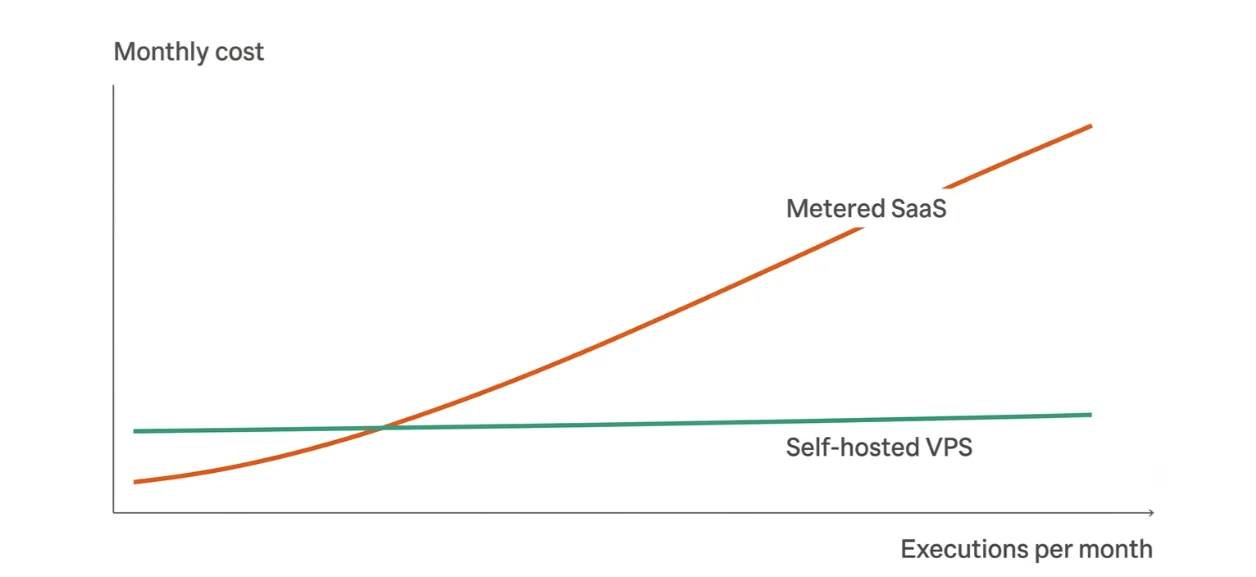
Most SaaS automation tools price you per task, per execution, or per ‘zap.’ Your bill grows every time your usage grows.
n8n doesn’t work that way.
When you self-host, your cost is your server bill. Nothing more.
That’s a fixed, predictable monthly cost, no matter how many workflows you run.
There’s no per-seat pricing either. Add your whole team without paying more per person, something that would cost you extra on most metered platforms.
Here’s a simple way to picture it. A business running several thousand executions a month on a metered SaaS tool can watch its bill climb into the hundreds of dollars.
That same volume, run on a $5–10/month (≈₦6,850–₦13,700/month) VPS through us at Truehost, costs you a flat fee regardless of how busy your workflows get.
There are no feature paywalls on the core engine either. Conditionals, loops, and code nodes come free, not locked behind a higher tier.
Your cost curve stays flat as you scale. It doesn’t climb every time you add a workflow.
Want predictable hosting costs from day one? You can self-host n8n on a Truehost VPS and skip the per-execution math entirely.
For context, n8n’s own cloud plans start at roughly €24/month (≈₦37,400/month) for a basic tier, scaling up through Pro and Business plans as your execution volume grows.
Zapier’s Professional plan can run $30–50/month (≈₦41,100–₦68,500/month) for a modest 500 monthly executions once you factor in multi-step tasks.
Make’s Core plan sits closer to $10/month (≈₦13,700/month) for 10,000 operations, which is more competitive, but it still scales with usage.
Self-hosting removes that scaling variable entirely.
Your server cost stays the same if you run 500 executions a month or 50,000.
That’s roughly $5–10/month (≈₦6,850–₦13,700/month) at current exchange rates. The figure doesn’t move, no matter how much your automation volume grows.
2) Full Data Privacy & Control
Your workflow data stays on your own infrastructure. Nothing routes through a third-party cloud by default.
You choose where it lives. Deploy fully on-prem, or run it on a private VPS via Docker.
This is important if you work under compliance rules. Think GDPR, Nigeria’s NDPA (Nigeria Data Protection Act), or client confidentiality agreements. It also important if you work in health, finance, or legal services.
No outside company touches your automation data, your API keys, or your business logic. Not unless you choose to give them access.
You also decide your own retention policy. How long you keep execution logs is your call, not a vendor’s default setting.
If you’re an agency or freelancer automating client workflows, this point carries extra weight. Client data never passes through a shared, multi-tenant SaaS environment.
3) Code Flexibility & No Vendor Lock-In
You get full access to the underlying source code for internal use. You’re not stuck with pre-built templates or vendor-approved logic.
Need something the vendor hasn’t built? Build a custom node yourself, for an internal tool or a niche API with no official integration.
You can also install community-built nodes from npm. That extends what n8n does without waiting on anyone’s roadmap.
Need to drop in a script? Native code nodes let you write JavaScript or Python directly inside a workflow. No separate scripting environment required.
You own your workflow files outright. Export and import them freely. Switch providers, and you keep every automation you built.
And because you’re not tied to a single vendor’s decisions, your self-hosted instance keeps running no matter what happens to that vendor’s pricing, features, or roadmap.
4) No Limits on Scale
Self-host n8n, and you get unlimited workflows and unlimited executions. No artificial caps tied to a subscription tier.
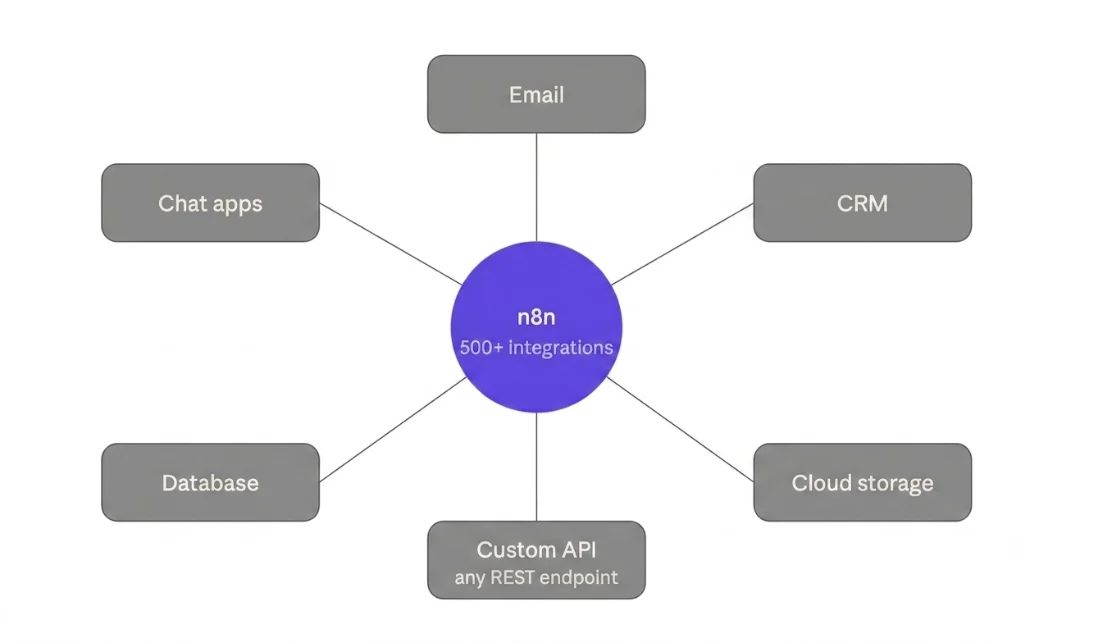
The official catalog now covers 500+ pre-built integrations. That spans CRMs, email, databases, cloud storage, and communication apps. Count community-published nodes too, and the real number climbs well past 1,000.
Missing a dedicated node for something niche? The HTTP Request node connects to almost any REST or GraphQL API, even services with no official integration at all.
There’s no concurrency limit imposed by a billing tier either. Your execution volume scales with your own server resources, not a subscription cap.
Complex, branching, multi-step workflows run without hitting the ‘workflow complexity’ ceilings some SaaS tools impose.
5) Large, Active Ecosystem
n8n’s template library now holds over 10,000 community-built workflows. Import one, tweak it, and skip building from a blank canvas.
The community itself has grown to over 200,000 members. That’s people contributing solutions, troubleshooting help, and shared workflows daily.
On GitHub, the project has crossed nearly 200,000 stars. That kind of number reflects sustained developer trust, not a passing trend.
Beyond the numbers, there’s an active public forum for troubleshooting. Pair that with in-depth official documentation, and most problems already have a documented answer.
New nodes and integrations, including AI-related ones, get added regularly. The platform keeps pace with new tools and APIs as they show up.
With a community this size, niche problems, uncommon integrations, edge-case errors, usually already have a fix somewhere in the forum.
That scale also shows up in the community-built node ecosystem.
Thousands of community node packages exist on npm, built and maintained by developers outside n8n’s core team.
If you can’t find an official node for a tool you use, there’s a good chance someone already built and published one.
6) Full Control Over Your Automation
Your automation runs entirely where you decide. Your server. Your infrastructure. Your rules.
Nobody forces an update on you. You choose when, and whether, to upgrade.
There’s no risk of a surprise price hike either. You’re not on a subscription tied to usage, so there’s nothing to spike.
You also won’t wake up to a vendor deprecating a feature you depend on. You control your own version and configuration.
For teams that need deeper governance, self-hosting still supports enterprise-grade control. Role-based access, SSO/SAML, and audit logging are all available when you need them.
The One Thing to Know Before You Rely on This
Here’s the one limitation worth knowing clearly.
You can’t repackage or resell n8n as your own hosted product. Not without a separate agreement with n8n directly.
Who does this affect? Mostly people trying to build and sell a competing SaaS platform using n8n’s code.
If you’re automating your own business, or building workflows for clients, this restriction doesn’t touch you.
There is a point where n8n Cloud or n8n Enterprise makes more sense than self-hosting.
If you’d rather skip server management entirely, or you need dedicated enterprise support and SLAs, their managed plans exist for that reason.
For everyone else, self-hosting stays the more cost-effective, more flexible route.
Get n8n With Truehost
We at Truehost make self-hosting n8n simple, even if you’ve never managed a server before.
Here’s why that pairing works well. You get full control over your data and your infrastructure, the way n8n’s fair-code model intends.
And you get a VPS built and supported for the Nigerian market, without the guesswork of setting one up alone.
Our VPS plans give you the resources n8n needs to run reliably, from a small internal automation setup to a business running thousands of monthly workflow executions.
You get root access, predictable monthly pricing, and support when you need it.
Ready to stop paying per execution? Self-host n8n on a Truehost VPS and keep full ownership of every workflow you build.
Is n8n Open Source FAQ
Why isn’t n8n open source if the code is public?
Public code alone doesn’t qualify a project as open source under OSI’s definition. n8n’s Sustainable Use License adds one restriction: you can’t resell n8n as your own hosted product. That single limitation is enough for n8n to avoid the open source label itself, even though the code sits publicly on GitHub and remains free to use, modify, and self-host.
What can’t I do with n8n’s free license?
You can’t take n8n’s code and offer it as a competing hosted automation service under your own brand. Outside of that one commercial restriction, you can use, modify, and run n8n freely, including for internal business use and client work.
Is self-hosted n8n free forever?
Yes. The Community Edition, self-hosted under the Sustainable Use License, carries no license fee and no time limit. Your only ongoing cost is your server, whether that’s a Truehost VPS or another hosting setup.
Is n8n ‘fair-code’ the same as ‘open source’?
No, but it sits close. Fair-code means the source is public, free to use, and free to extend, with one commercial restriction attached. Open source, by OSI’s definition, permits no restrictions on use at all. n8n created the fair-code term specifically to describe this middle ground.
Can I use n8n for client work as an agency or freelancer?
Yes. Building and running automations for clients on your own or your client’s infrastructure falls well within the license. The restriction only applies if you try to resell n8n itself as a hosted product under your own brand.
How is n8n different from Zapier or Make in terms of licensing?
Zapier and Make are closed, proprietary SaaS platforms. You can’t see their code, modify their logic, or host them yourself. n8n’s source is public and self-hostable under its fair-code license, giving you a level of access and control that closed platforms simply don’t offer.