 Domain NamesFind and register your ideal domain name instantly.
 Web HostingEasy-to-use hosting powered by cPanel — ideal for managing websites in Nigeria.
 Windows HostingRun .NET apps with Windows-optimized hosting
 Affiliate ProgramMake money promoting our services
 Reseller HostingMake money by reselling our hosting products under your own brand
 .COM Domains
 All DomainsExplore all supported tld domains in Nigeria
 WhoisFind out who owns any domain, as well as verify your registration details
 VPS Hosting in Nigeria
 Dedicated ServersReimagine your site speed with your own complete server
 AI Website BuilderDesign your site with drag-and-drop tools
 Online Store BuilderStart your online shop without code
 Support PortalFind answers or get expert help
 Contact UsReach our team via chat or email
 BlogRead our extensive guides on web hosting and more
Microsoft 365 is one of the most widely used productivity platforms in the world.
Walk into almost any corporate office, and there is a good chance the entire team is running on Outlook, Word, Excel, and Teams.
The brand recognition alone makes it the default choice for a lot of businesses, especially those that grew up using Microsoft Office on desktop and never really questioned whether there was a better or cheaper option.
But here is the thing: Microsoft 365 has multiple plans, regional pricing variations, add-ons that stack on top of base prices, and a July 2026 price increase that quietly affects what businesses are paying.
Knowing the actual microsoft email cost: what you are paying, what you are getting, and whether it is genuinely worth it for your specific situation, requires sitting down and going through the numbers honestly.
That is exactly what this guide does.
We break down every pricing tier from Personal to Enterprise, compare Microsoft against Truehost as an alternative for Nigerian businesses, and give you a straight answer on whether the cost is justified for the type of business you are running.
Microsoft 365 Pricing Tiers: Complete Breakdown
Microsoft 365 is not one product with one price.
It is a family of plans designed for different user types, personal users, small business teams, and large enterprise organisations.
Each tier comes with a different feature set, a different storage allocation, and a very different price tag.
Here is how they break down.
A) Personal and Family Plans
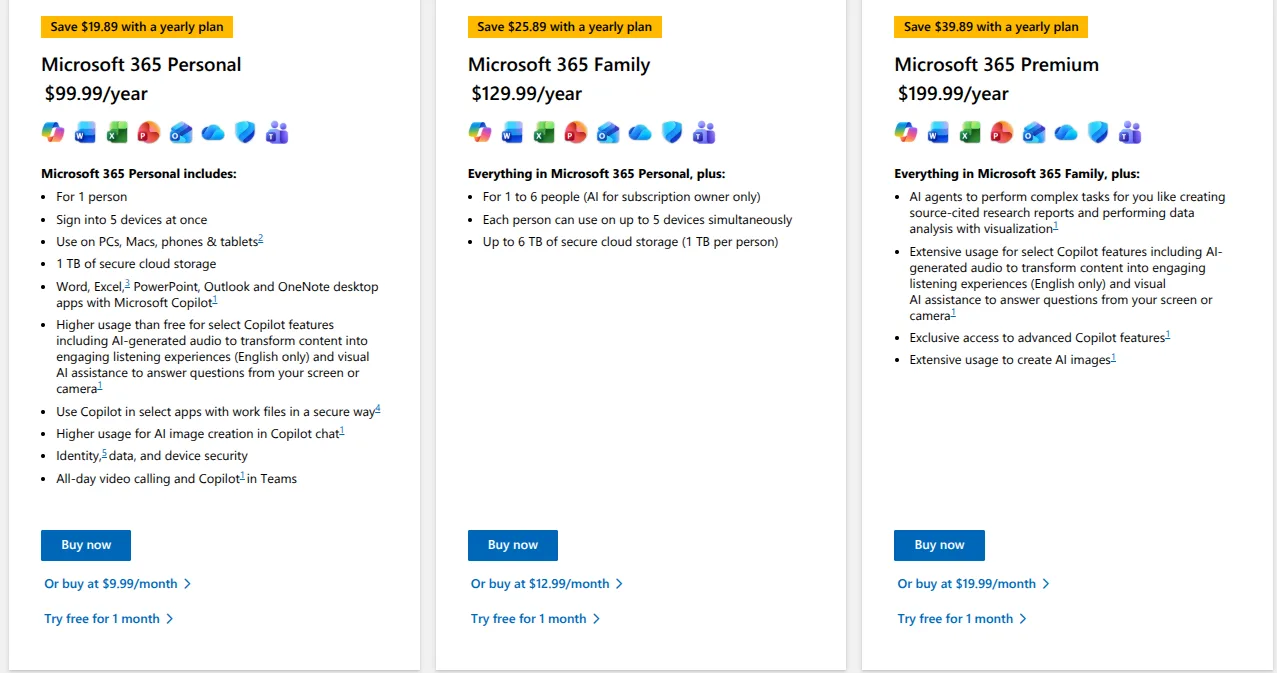
These plans are designed for individual and household use.
They are not intended for business operations, and Microsoft’s terms of service are clear on that.
If you are using a Personal or Family plan to run a business, you are technically outside what the plan is built for, which matters if you ever need to claim support or enforce any kind of service guarantee.
That said, these plans are worth understanding because a lot of small business owners in Nigeria start here before realising they need something more appropriate.
- Microsoft 365 Personal is priced at ₦71,999 per year or ₦7,199 per month. It covers one user on up to five devices and includes 1 TB of OneDrive cloud storage. You get the full desktop versions of Word, Excel, PowerPoint, and Outlook, plus Microsoft Teams and Microsoft Defender for security.
- Microsoft 365 Family costs ₦88,999 per year or ₦8,899 per month and extends coverage to up to six people, each with their own 1 TB of OneDrive storage, 6 TB in total across the household. The app access is the same as Personal: Word, Excel, PowerPoint, Outlook, Teams, and Defender.
The naira pricing on these plans is notable because it is one of the few Microsoft 365 tiers that bills in local currency for Nigerian users.
The business plans, which most organisations actually need, do not share that convenience, they bill in US dollars, which we will get to shortly.
B) Business Plans (Up to 300 Users)
This is where most small and medium-sized businesses sit, and this is also where the microsoft email cost conversation gets more complicated.
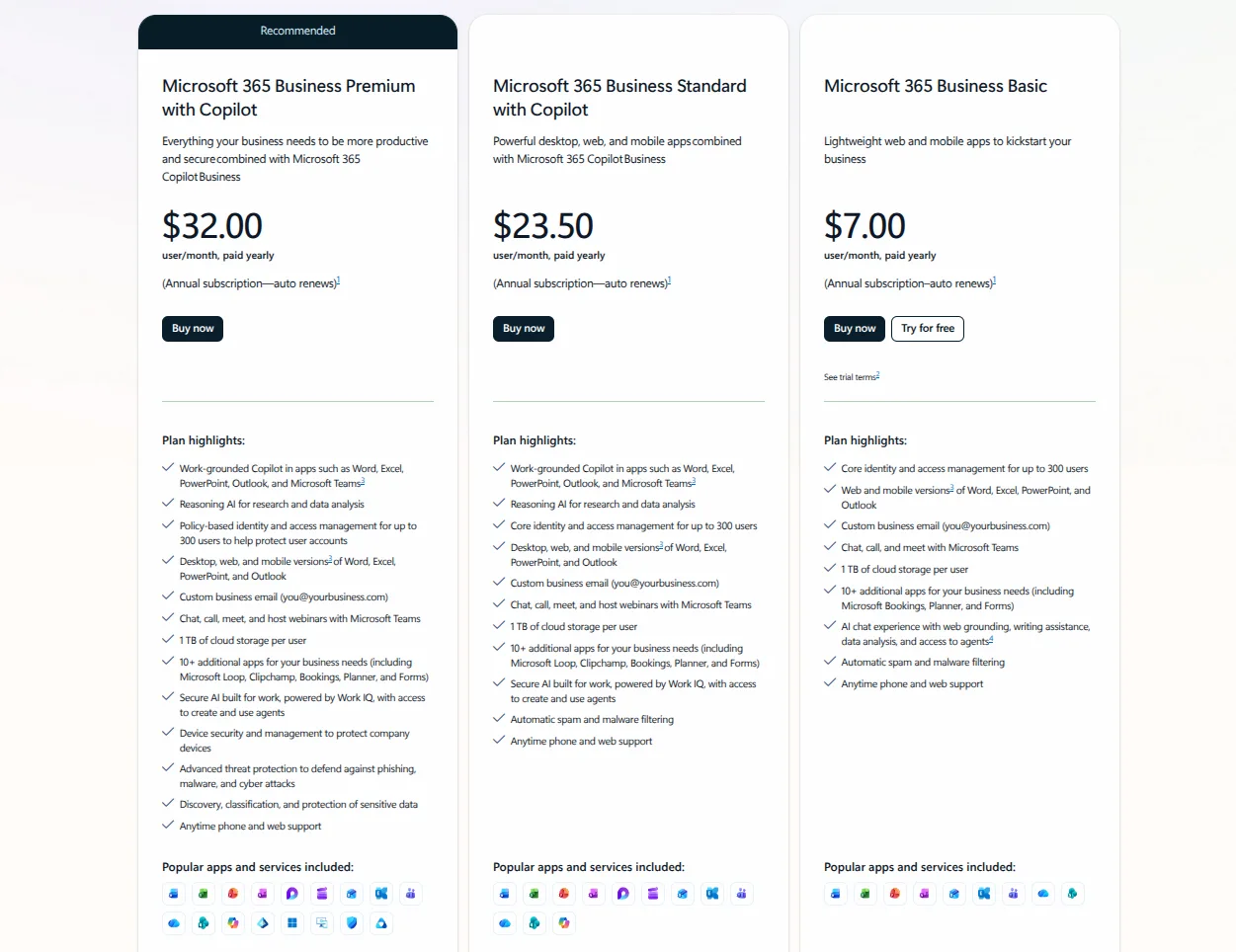
Business plans are billed in USD per user per month on an annual commitment. From July 1, 2026, prices are increasing across most tiers.
Here is the full picture:
| Plan | Current Price (USD/user/month) | New Price from July 2026 (USD/user/month) | Key Features |
|---|---|---|---|
| Business Basic | $6.00 | $7.00 | Web & mobile Office apps, 50 GB mailbox, 1 TB OneDrive, Teams |
| Business Standard | $12.50 | $14.00 | Everything in Basic + desktop Office apps, webinars, Teams |
| Business Premium | $22.00 | $22.00 (No change) | Everything in Standard + advanced security & device management |
- Business Basic is the entry point for professional Microsoft email. At $7 per user per month from July 2026, you get web and mobile versions of the Office apps, meaning no desktop installs, a 50 GB mailbox per user, 1 TB of OneDrive storage, and access to Microsoft Teams. For a team of five, that is $420 per year. For a team of twenty, you are at $1,680 per year before you add anything else. All in US dollars.
- Business Standard moves to $14 per user per month from July 2026 and adds desktop versions of Word, Excel, PowerPoint, and Outlook, plus the ability to host webinars and access more advanced Teams features. This is the plan most businesses that actually use Microsoft Office regularly will need, because the web-only apps on Basic are functional but limited compared to the full desktop experience. For a team of ten, Business Standard at the new pricing comes to $1,680 per year.
- Business Premium holds steady at $22 per user per month and adds enterprise-grade security and device management on top of everything in Standard. This includes Microsoft Defender for Office 365, Advanced Threat Protection, and Microsoft Intune for mobile device management. For businesses in regulated industries or those managing sensitive client data, these features are worth the premium. For a team of ten, Business Premium is $2,640 per year.
If you do not need Microsoft Teams, Microsoft also offers lower-cost alternatives across the same tiers:
| Plan | Price (USD/user/month) |
|---|---|
| Business Basic (no Teams) | $4.40 |
| Business Standard (no Teams) | $9.29 |
| Business Premium (no Teams) | $18.79 |
This is worth knowing because Teams is one of the biggest cost drivers in the standard plans.
If your team already uses Zoom, Google Meet, or WhatsApp for communication and has no intention of switching, paying for Teams bundled into your email plan is essentially wasted spend.
Microsoft Copilot AI Add-on
Microsoft has also introduced Copilot, its AI assistant, as a paid add-on across all business plans. The pricing looks like this:
| Plan | Price with Copilot (USD/user/month) |
|---|---|
| Business Basic + Copilot | $36.00 |
| Business Standard + Copilot | $42.50 |
| Business Premium + Copilot | $52.00 |
Copilot integrates AI assistance directly into Word, Excel, Outlook, and Teams, helping with drafting emails, summarising documents, generating formulas, and more.
It is genuinely useful for businesses that are heavy Microsoft Office users. But at those price points, it is firmly in the nice to have if budget allows category rather than something most small Nigerian businesses need to consider right now.
C) Enterprise Plans (Larger Organisations)
Enterprise plans are built for large-scale deployments where advanced compliance, analytics, security controls, and regulatory requirements become critical.
These are not plans you stumble into as a small business, they are designed for organisations with dedicated IT departments, compliance officers, and legal teams.
| Plan | Current Price (USD/user/month) | New Price from July 2026 (USD/user/month) |
|---|---|---|
| E3 | $36.00 | $39.00 |
| E5 | $57.00 | $60.00 |
- Microsoft 365 E3 at $39 per user per month from July 2026 includes the full Office suite, unlimited email archiving, advanced compliance tools, and information protection features. For a 100-person organisation, that is $46,800 per year, a significant commitment that only makes financial sense when the compliance and security features are genuinely required by the nature of the business.
- Microsoft 365 E5 at $60 per user per month is the most comprehensive tier, adding advanced analytics, Power BI Pro, Microsoft Defender for Endpoint, and the deepest security and compliance capabilities in the Microsoft ecosystem. This is enterprise infrastructure pricing, and it is priced accordingly.
A note that applies across all business and enterprise plans: pricing can vary by region, billing cycle, and volume commitments. The figures above represent standard annual billing.
Volume licensing agreements for larger organisations may shift these numbers, but those are negotiated directly with Microsoft and are not available to most small or medium businesses.
Microsoft Email vs Truehost Email
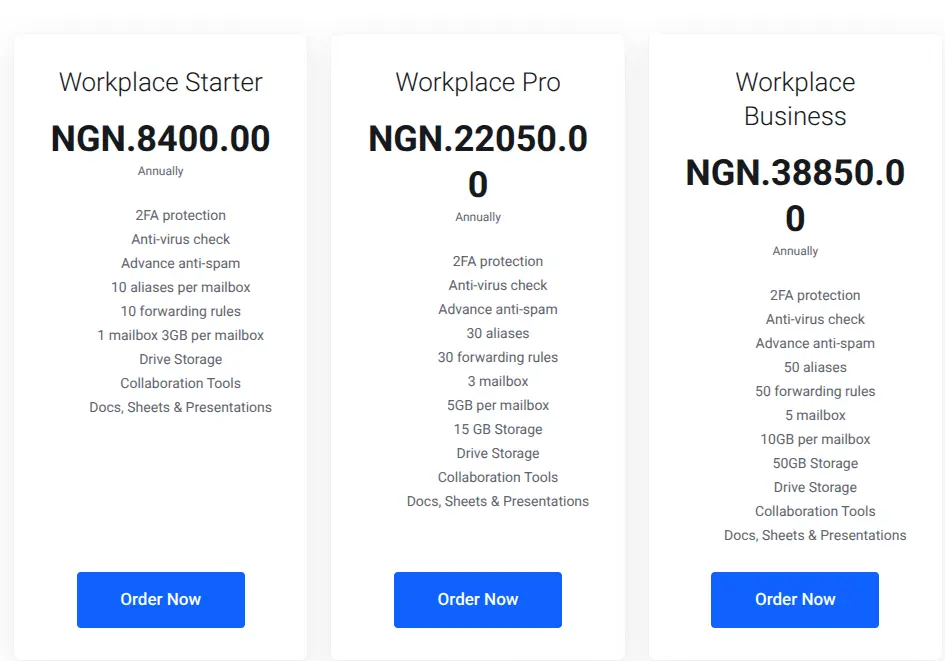
To put the microsoft email cost in context for Nigerian businesses, it helps to compare it directly against a local alternative.
Truehost is a hosting provider built specifically for the African market, and their Workplace email plans are designed for exactly the kind of business that needs professional email without the overhead of a full productivity suite.
Here is how the two platforms compare on the features that matter most:
| Feature | Microsoft 365 Business Basic | Truehost Workplace |
|---|---|---|
| Starting Price | $6.00/user/month (rising to $7.00) | ₦8,400/year (Starter plan) |
| Naira Pricing | USD-billed | Naira-billed |
| Custom Domain Email | Yes | Yes |
| Mailboxes Included | 1 per user (scalable) | 1 (Starter) / 5 (Business) |
| Storage per Mailbox | 50 GB | 3 GB (Starter) / 10 GB (Business) |
| Cloud/Drive Storage | 1 TB OneDrive | None (Starter) / 50 GB (Business) |
| Desktop Office Apps | No (web/mobile only on Basic) | No |
| Collaboration Tools | Microsoft Teams | Basic Docs, Sheets & Presentations |
| Video Conferencing | Yes (Teams) | No |
| Anti-Spam & Antivirus | Yes | Yes |
| 2FA Security | Yes | Yes |
| Email Aliases | Yes | 10 (Starter) / 50 (Business) |
| Forwarding Rules | Yes | 10 (Starter) / 50 (Business) |
| 24/7 Support | Yes | Yes |
| Per-User Billing | Yes (cost scales with team) | No (flat rate) |
| Free Migration | No | Yes |
A few things stand out when you look at this side by side.
- Storage is the clearest win for Microsoft. A 50 GB mailbox per user on Business Basic is significantly more generous than Truehost’s 3 GB on the Starter plan. If your business stores years of email correspondence, handles large attachments regularly, or has legal or compliance reasons to maintain long email archives, Microsoft’s storage allocation is very important. Truehost’s higher-tier plans offer more, up to 100 GB per mailbox on Workplace Premium, but the entry-level gap is real.
- Billing currency is the clearest win for Truehost. Microsoft’s business email plans are billed entirely in US dollars, with no naira option. Every billing cycle, your cost in naira depends on whatever the exchange rate is doing that month. For a Nigerian business managing tight cash flow, that unpredictability is a genuine operational problem. Truehost bills in naira. Full stop. Your renewal price is your renewal price.
- Pricing model is another meaningful difference. Microsoft charges per user, which means every new team member you add increases your monthly bill proportionally. A team of two on Business Basic at $7 per user per month costs $168 per year. A team of fifteen costs $1,260 per year. The cost scales linearly upward. Truehost uses a flat-rate model, you pay for a plan, not for each individual user added to that plan. For a growing business, that difference becomes significant quickly.
- Collaboration and productivity tools is Microsoft’s strongest argument. If your team genuinely uses Teams for daily communication, relies on desktop Word and Excel for document-heavy work, and benefits from SharePoint for internal document management, those tools have real productivity value. Truehost’s basic collaboration tools, browser-based Docs, Sheets, and Presentations, cover simple document needs but are not a substitute for a team that is deeply embedded in the Microsoft ecosystem.
- Support accessibility is closer than most international comparisons would suggest. Both platforms offer 24/7 support. The difference is that Truehost’s support team is Nigeria-based, operates in the same timezone, and is reachable through WhatsApp and local phone lines alongside standard chat and email tickets. Microsoft’s support is global, competent, and well-documented, but it is not designed for the specific context of a Nigerian small business navigating local DNS configurations, naira payment friction, or regional hosting decisions.
Is Microsoft Email Worth the Cost?
This is the question the whole comparison leads to, and the honest answer is: it depends entirely on what your business actually needs.
For large organisations, the answer is yes.
If you are running a team of fifty or more, operating across multiple locations, managing sensitive data that requires enterprise-grade compliance tools, or already deeply embedded in the Microsoft ecosystem with SharePoint, Teams, and Outlook as the backbone of daily operations, Microsoft 365 delivers real value at the Business Standard and Premium tiers.
The integration across every tool, the depth of the security stack on Premium and Enterprise plans, and the reliability of the infrastructure are genuinely difficult to replicate at the same price point elsewhere.
For Nigerian startups and small businesses, the case is weaker.
Here is the practical reality: Business Basic at $7 per user per month from July 2026 gives you web-only Office apps, not desktop installs, a 50 GB mailbox, and Teams.
If your team primarily needs professional branded email and occasionally uses shared documents, you are paying for infrastructure that significantly exceeds what you are actually using.
And you are paying for it in dollars, which means your costs in naira are unpredictable every single billing cycle.
A team of ten on Business Basic from July 2026 is paying $840 per year.
Add the exchange rate at the time of writing and you are looking at a substantial naira figure that most SMEs did not budget for at the start of the year.
Scale that to Business Standard for desktop Office apps and you are at $1,680 per year for ten users, before adding Copilot, before adding any premium security features, before factoring in any rate movement.
That is where Truehost makes a compelling case for the majority of Nigerian small businesses.
Starting at ₦8,400 per year on the Workplace Starter plan, one mailbox, 3 GB storage, antivirus, anti-spam, two-factor authentication, aliases, and forwarding rules, the entry cost is dramatically lower.
The flat-rate pricing model means adding team members does not automatically add to your bill. Free migration is included.
And the entire relationship, from initial setup to renewal to support calls, happens in naira and in your timezone.
The smartest approach for most Nigerian businesses is to start where your needs actually are, not where you think you should be.
Professional email, solid security, local support, naira billing. Get those right first, and make the bigger investment when the bigger need arrives.