 Domain NamesFind and register your ideal domain name instantly.
 Web HostingEasy-to-use hosting powered by cPanel — ideal for managing websites in Nigeria.
 Windows HostingRun .NET apps with Windows-optimized hosting
 Affiliate ProgramMake money promoting our services
 Reseller HostingMake money by reselling our hosting products under your own brand
 .COM Domains
 All DomainsExplore all supported tld domains in Nigeria
 WhoisFind out who owns any domain, as well as verify your registration details
 VPS Hosting
 Dedicated ServersReimagine your site speed with your own complete server
 AI Website BuilderDesign your site with drag-and-drop tools
 Online Store BuilderStart your online shop without code
 Support PortalFind answers or get expert help
 Contact UsReach our team via chat or email
 BlogRead our extensive guides on web hosting and more
Mostly, when you’re looking through hosting provider websites, you see so many of options until you’re wondering how many types of web hosting are there?
And what does each do?
Today we wipe away that confusion and make sure you totally understand the type of web hosting you need and why.
Now, another thing is cost, and as you’ve seen, they all cost differently.
You don’t want to be spending all your money renting a whole maisonette, while all you need is a single room.
In terms of web hosting, you need a type that is within your website needs. You could use that money for something else, right?
Again, you need to be sure to pick the right setup, because the wrong one will cost you dearly.
So, to help you understand and choose the right type of web hosting, I made this guide for you.
In it, we’ll be breaking down the types of web hosting, plus the exact plans in the market for you.
Here’s a quick peek at what we’ll cover:
- A quick rundown of the different types of web hosting
- Each type of web hosting explained
- Different plans that are available offering those types of web hosting
Oya, let’s get your site soaring with the right type of hosting.
What Are the Different Types of Web Hosting?
Web hosting is like renting a little corner of the internet where your website lives.
Being your digital shopfront, if your hosting isn’t solid, visitors won’t even make it to the door.
Now, about the types, we have several, each offering a different level of power, price, and control.
And the one thing for sure, choosing the right one saves you money and stress.
The Main Types of Web Hosting
Here are the main types you’ll see powering most Nigerian websites:
- Shared Hosting: This is the most affordable option. Great for small sites, but it can get crowded.
- VPS Hosting: This now is a step up. You still share a server, but you get more breathing room.
- Dedicated Hosting: This is the premium option. This is your private villa on the internet. Full control, full power, and a higher budget.
- Cloud Hosting: This one is flexible and scalable. In this case, your site taps into multiple servers, so it can grow or handle sudden traffic without breaking a sweat.
- Reseller Hosting: Ideal if you want to sell hosting to clients. You rent space wholesale and package it under your own brand.
Why Choose a Hosting Type
Now, with our current realities in Nigeria, say unstable power, mobile-first users, and the need for reliable uptime, they demand hosting that won’t crumble at the first hiccup.
That’s why Truehost plans are built for exactly this.
With data centers in Lagos plus automatic backups, that don’t flinch during blackouts, your site stays online and fast.
So, pick the wrong hosting, and you’ll pay in frustration later. Pick the right one, and your site can grow smoothly with your business.
Now, let’s look at which hosting type fits you best.
1) Shared Hosting
Shared hosting is usually where most beginners start, and for good reason.
It’s like sharing an apartment, where several websites live on the same server, splitting the cost and resources.
You get what you need at a price that’s easy on the pocket, as long as your traffic is still light.
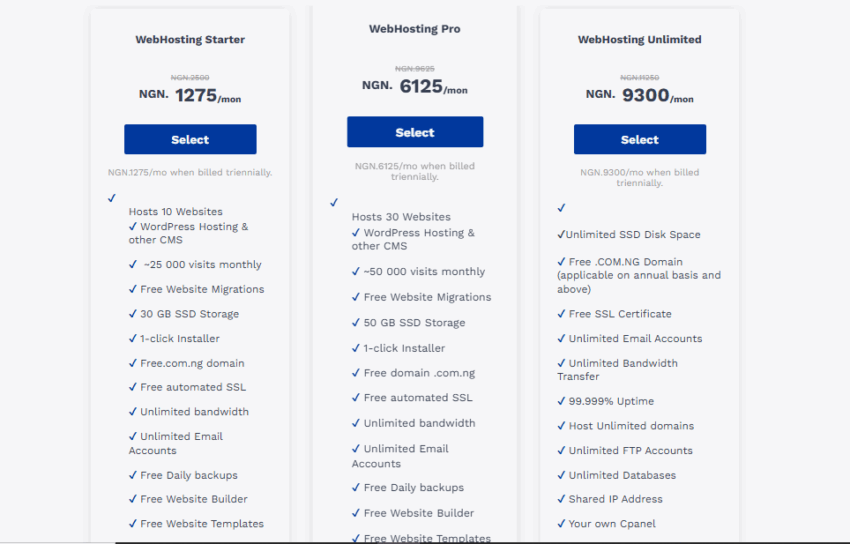
Shared hosting works perfectly for personal blogs, small portfolios, or new online stores pulling up to about 50,000 visits a month.
Why people love it: it’s cheap, it’s simple, and with one-click installs, you can go from “zero” to “up and running” in minutes. You also get unlimited bandwidth, so those WhatsApp shares won’t crash your site.
The catch? If another site on the same server suddenly blows up in traffic, you might feel a slight slowdown, kind of like hitting the brakes during rush hour on Third Mainland Bridge.
Take a small business owner using our WebHosting Starter plan at ₦1,275/month (billed triennially—49% off the original ₦2,500).
It gives them 30GB SSD storage, a free .com.ng domain, unlimited emails, and cPanel to tweak things whenever they want.
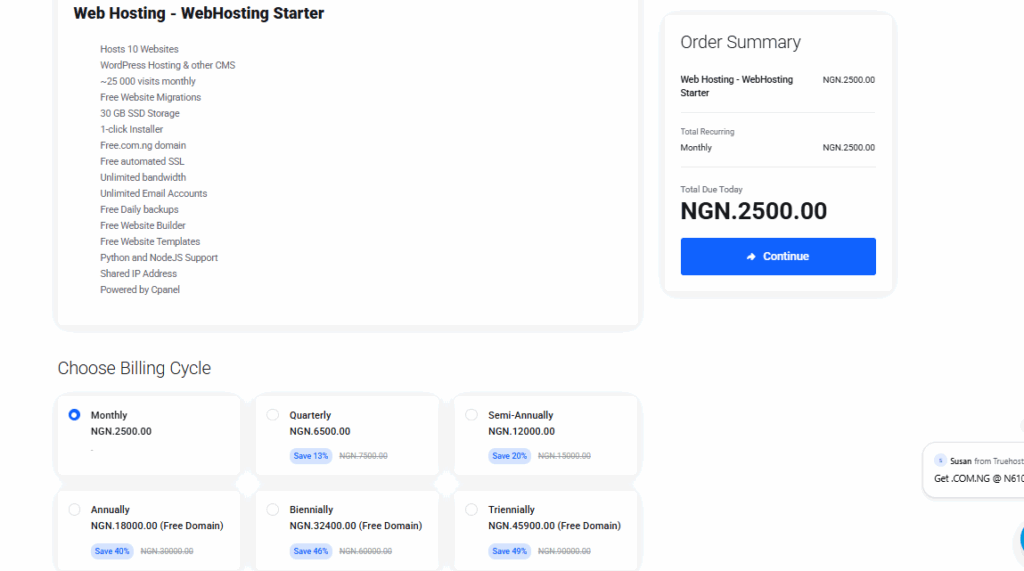
If they outgrow that, they can always jump to the Pro plan (₦6,125/month, 50GB storage).
And because you’re building for a Nigerian audience, here’s a bonus: our Lagos data center keeps your load times fast for local visitors.
You also get free SSL for secure checkouts. .
If you’re just testing the waters, shared hosting is honestly the easiest place to begin.
You can even migrate for free when you’re ready. In short, you can start small, grow comfortably, dream big.
2) VPS Hosting
So, your blog is finally blowing up, but now shared hosting is starting to feel… cramped.
It’s time to think about VPS (Virtual Private Server) hosting.
VPS is like moving from economy to business class: you still share the plane, but you get your own spacious seat, your own overhead bin, and no one’s elbowing you for resources.
With VPS, you get dedicated RAM and CPU power, root access if you like tinkering under the hood, and the freedom to scale when your traffic grows.
It’s great for your mid-sized website, and others like growing e-commerce stores, active forums, and sites pulling in 50,000+ monthly visitors.
Why it works for many: You’re isolated from noisy neighbors (so no surprise slowdowns), you get extra muscle during traffic spikes, and you have full control over your environment.
What to keep in mind: It costs a bit more than shared hosting, and unmanaged plans require some technical know-how.
The good news? We offer managed options if you’d rather not touch the backend.
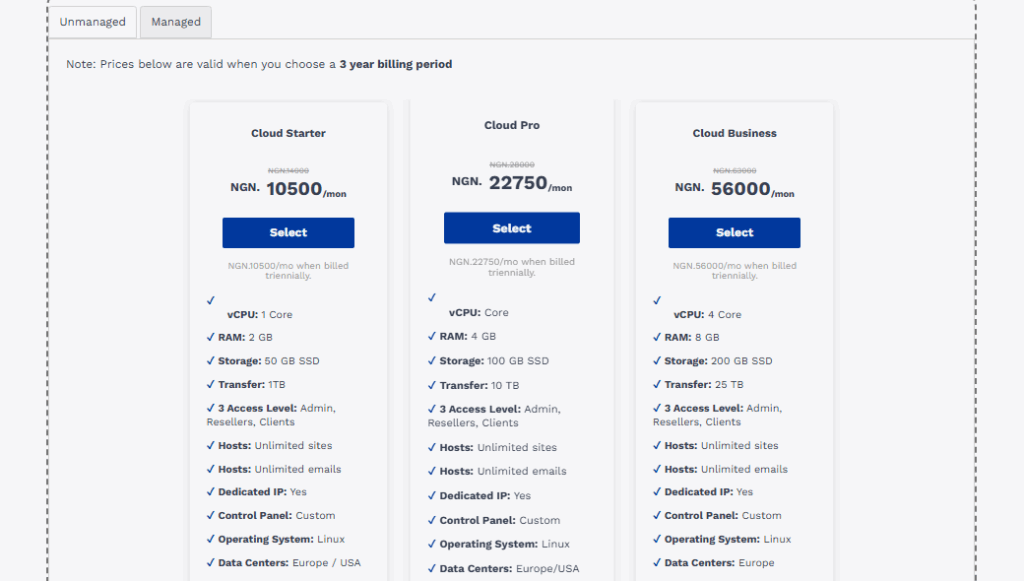
Our VPS performs beautifully in Nigeria thanks to nearby Kenyan servers and local data centers and round-the-clock Pidgin-English support.
And if you’re not tech-savvy, no worries, since our managed VPS plans take care of updates and maintenance for you.
3) Dedicated Servers
If your website has grown into a full-blown success, think high-traffic e-commerce stores or apps handling thousands of transactions every day, shared hosting or a VPS just won’t keep up.
In this case, dedicated servers are your rescue party.
With this premium option, you’re essentially renting an entire physical machine.
No neighbors, no resource sharing, just pure, uninterrupted CPU, RAM, and storage for maximum speed and security.
Dedicated servers are ideal for enterprise-level platforms like banks, fintech apps, or media sites pulling in 100,000+ daily visits.
The perks are big: top-tier performance, fully customizable setups, and rock-solid isolation.
The trade-off: Higher costs and a bit more setup time. But for mission-critical systems, the reliability pays for itself.
At ₦91,000/month (with our 20% triennial discount), the H1 delivers 32GB RAM, 2×240GB SSD, a Linux OS, and KVM virtualization for fine-tuning.
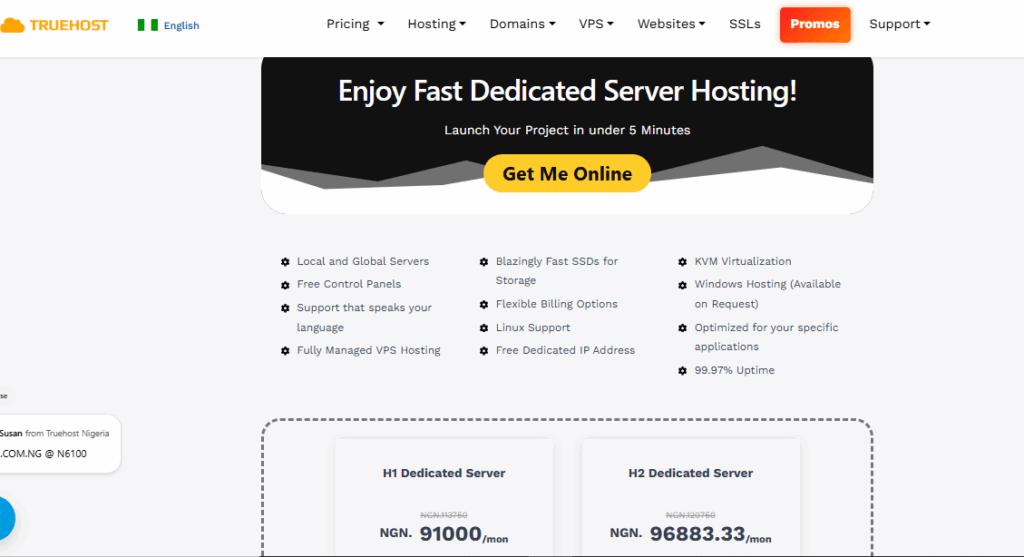
And for customers in Nigeria, hosting through our local and global data centers helps you stay compliant with data regulations while keeping latency low for users across West Africa.
Add enterprise-grade firewalls and our Email Pro plan for secure team communication, and you get a complete, fully managed setup if you want us to handle the heavy lifting.
For platforms with serious demands, dedicated servers provide the stability and power they need.
4) Cloud Hosting
When it comes to website traffic, just like Sallah sales or election season, your numbers can spike without warning.
Cloud hosting saves the day here.
Instead of relying on one physical server, cloud hosting pulls power from multiple servers around the world.
You only pay for what you use, and when traffic surges, it automatically scales up to handle the load.
When things calm down, it scales back. Kind of like calling an Uber: boost when you need it, relax when you don’t.
Cloud hosting is perfect for sites that don’t have steady, predictable traffic.
Talk of news platforms, seasonal stores, event-based businesses, or just anything with sudden bursts of visitors.
Why people love it: it’s flexible, reliable (no single point of failure), and globally distributed.
What to watch out for: if you don’t monitor usage, costs can creep up. Thankfully, good dashboards and alerts make that easy to manage.
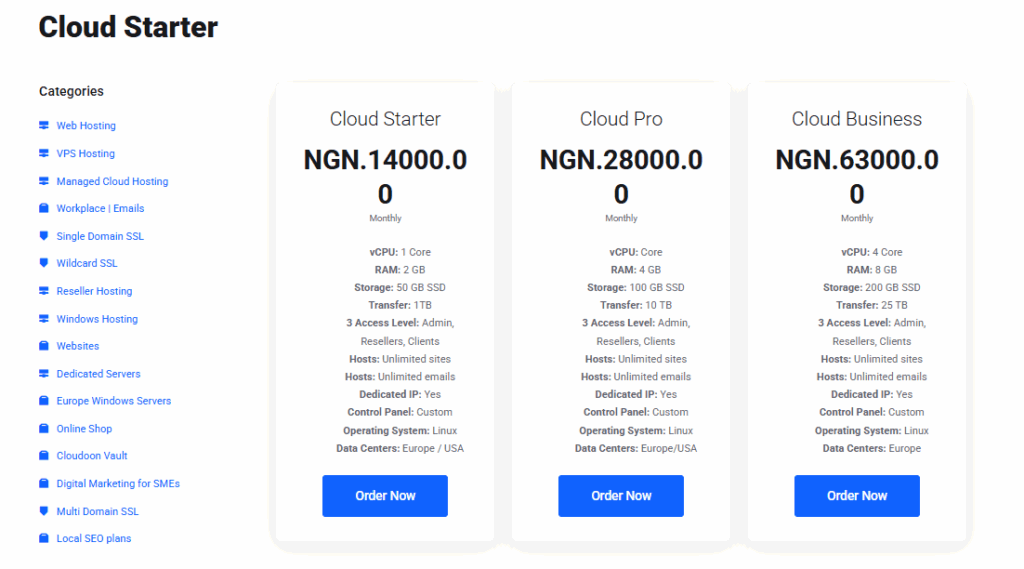
For ₦28,000/month, Cloud Pro gives you 4GB RAM, 100GB SSD storage, unlimited websites, a dedicated IP, and a Linux-ready environment with custom control panels.
And because our cloud uses servers in Europe and the U.S., Nigerian visitors enjoy consistently fast speeds.
Backups are built in, so even during outages, your data stays safe.
5) Reseller Hosting
Got clients lining up and asking for hosting? Reseller hosting will solve that for you.
It’s basically a business-friendly type of web hosting that lets you white-label and sell server space as if it were your own.
You can create sub-accounts, set your own prices, and essentially run a mini-hosting company without managing the heavy technical stuff.
It’s a great fit for agencies or freelancers who work with SMEs and want that extra stream of predictable income.
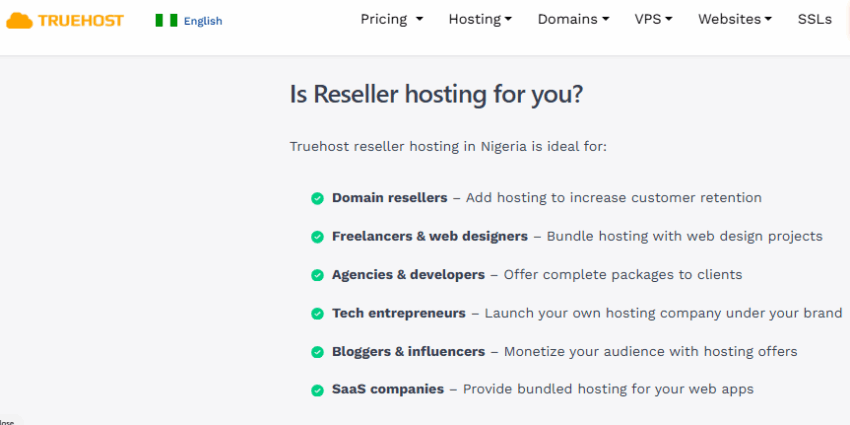
The perks: You get passive income and full branded control.
The catch: You’ll still need to manage clients, but thankfully, the built-in tools make that a lot easier.
For just ₦5,400/month, you get 30GB storage, 20 cPanel accounts, unlimited bandwidth, private nameservers, and JetBackup for peace of mind.
Everything is set up for Naija agencies, from instant provisioning, local billing, and easy add-ons to give clients more tools.
6) Windows Hosting (Compared to Linux Hosting)
Most people go straight for Linux because it’s the “default” great for PHP sites, WordPress, and general web hosting.
But Windows hosting gives you a server environment built on Windows which is best if your site or application needs Microsoft technologies or just a smooth, flexible setup.
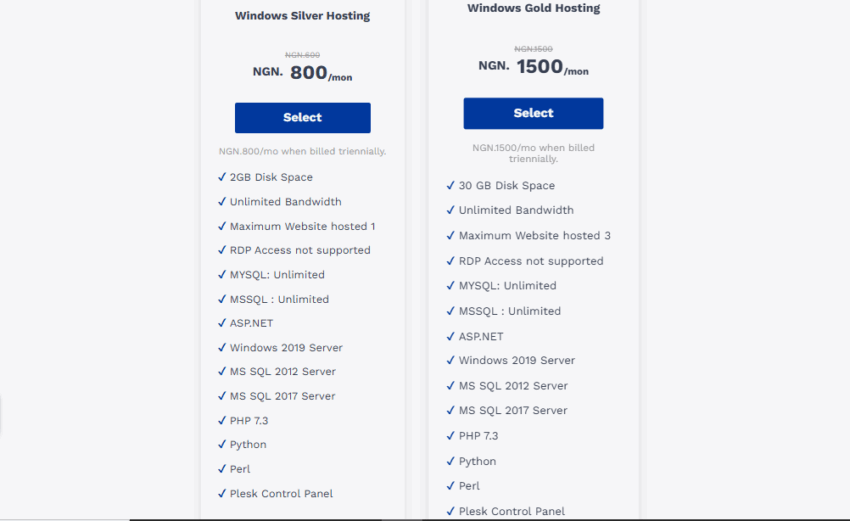
With Truehost Windows Hosting, you get full support for things like ASP.NET, MSSQL, PHP, Python, Perl, and more.
So, it works for everything from .NET apps to popular CMS sites.
It’s a great fit whether you’re running a corporate site, an online store, or even a blog.
For example, you still get 1-click installers (for WordPress, Joomla, Drupal, etc.), automatic SSL, and 24/7 security monitoring.
Pros: Works with a wide range of technologies so you’re not limited to just WordPress.
It includes a user-friendly control panel (Plesk), free SSL, automated security features, and 1-click app installs.
It’s also good for diverse websites, giving you flexibility if your needs change.
Cons: Might be more than you need if you only plan to run a simple static website.
It also slightly more complex stack (many supported technologies) so there’s a bit more to manage (or learn).
7) Managed vs. Unmanaged Hosting
When choosing between hosting types, you’ll also come across managed and unmanaged options.
Managed hosting is like having a dedicated tech team on standby to handle updates, security patches, performance tuning, backups, and troubleshooting are all handled for you.
It’s great if you want peace of mind without digging into server settings.
Unmanaged hosting, on the other hand, gives you full control but also full responsibility.
You get the raw server environment, and everything else from security, software installs, to optimizations, is on you.
It’s cheaper, yes, but best suited for developers or anyone comfortable managing their own stack.
Wrapping It Up
From shared’s budget boost to dedicated’s raw power, these types of web hosting fit every Naija stage.
So, you could just decide to pick your type and start launching today.
At Truehost, we make it even simple for you, with Naira plans, local support, free migrations.
Now, if you’re already eyeing a type hit truehost.com.ng/hosting and select your fit.
If you need more, chat us for a custom fit.
Oya, get online, your audience awaits.