 Domain NamesFind and register your ideal domain name instantly.
 Web HostingEasy-to-use hosting powered by cPanel — ideal for managing websites in Nigeria.
 Windows HostingRun .NET apps with Windows-optimized hosting
 Affiliate ProgramMake money promoting our services
 Reseller HostingMake money by reselling our hosting products under your own brand
 .COM Domains
 All DomainsExplore all supported tld domains in Nigeria
 WhoisFind out who owns any domain, as well as verify your registration details
 VPS Hosting
 Dedicated ServersReimagine your site speed with your own complete server
 AI Website BuilderDesign your site with drag-and-drop tools
 Online Store BuilderStart your online shop without code
 Support PortalFind answers or get expert help
 Contact UsReach our team via chat or email
 BlogRead our extensive guides on web hosting and more
Starting your first website is exciting, but it can also be overwhelming.
Many Nigerians focus on logos, colors, and content, but overlook the backbone of a website: hosting.
Picking the wrong hosting early can make your site slow, prone to downtime, insecure, or even hard to manage.
And the mistakes beginners make are often subtle, easy to miss but costly later.
This guide goes through the most common first website hosting mistakes Nigerians make and gives practical advice for avoiding them.
By the time you finish reading, you will know exactly what to look for so your website starts strong and grows without unnecessary hurdles.
1) Falling for Cheap Hosting Deals
One of the most common first website hosting mistakes beginners make is choosing a host based only on price.
When you are just starting out, a $1.99 per month offer from an international hosting company looks like a smart deal.
But cheap hosting often comes with hidden trade-offs that show up later.
Many low-cost providers oversell their servers.
This means hundreds or even thousands of websites share the same server resources.
When traffic increases, performance drops.
Your pages load slowly, and sometimes the site becomes temporarily unavailable. Speed is important, way more than many beginners realize.
According to Google, 53% of mobile users leave a website if it takes longer than three seconds to load.
Slow hosting can literally push visitors away before they even see your content.
Another issue is renewal pricing.
A plan that starts very cheap may increase significantly after the first year.
Many beginners don’t notice this until it is time to renew, and by then migrating to a new host feels stressful.
Industry experts at ICANN advise website owners to carefully review hosting terms, pricing structures, and service conditions before committing, especially when promotional offers are involved.
Instead of focusing only on the cheapest option, look at long-term value.
Check renewal costs, uptime guarantees, server performance, and support quality.
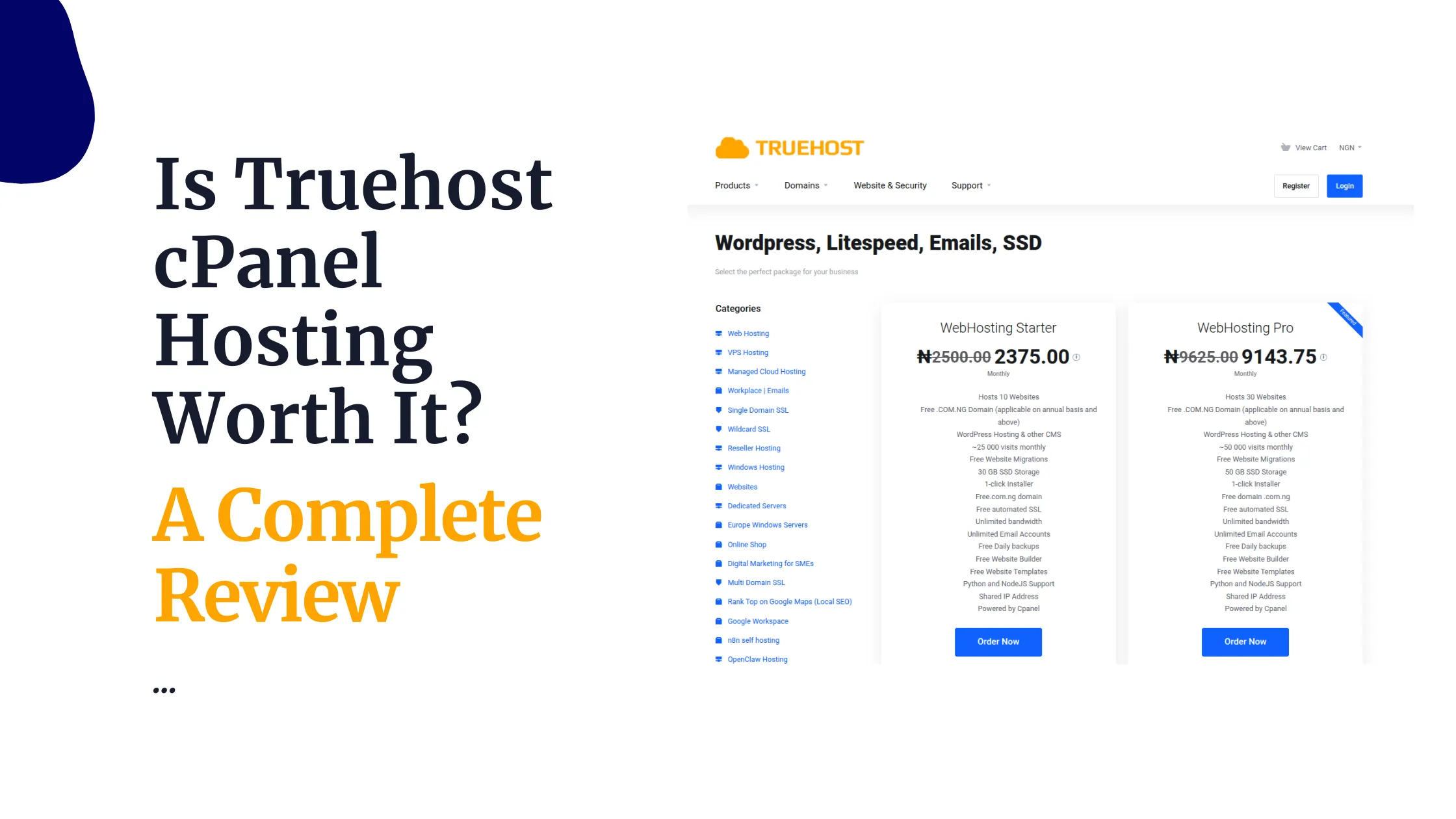
Affordable Nigerian hosting providers like Truehost offer transparent pricing, local payment options, and servers optimized for Nigerian traffic, which helps beginners avoid unnecessary performance and pricing surprises early on.
2) Choosing the Wrong Hosting Plan
Not every website needs the same type of hosting, yet many beginners choose a plan based on big promises instead of real needs.
This is one of the most overlooked first website hosting mistakes. Some people pay for a dedicated server when they only run a simple blog.
Others pick the cheapest shared hosting plan for an online store that expects steady traffic.
Both situations create problems.
Shared hosting is usually enough for blogs, personal portfolios, and small business websites with moderate traffic.
It is affordable and easy to manage.
But if you are running an eCommerce store, using heavy plugins, uploading large media files, or expecting frequent visitors, you may need VPS or cloud hosting for better performance and stability.
A study by HostingAdvice.com showed that about 40% of beginners upgrade their hosting within the first year because their initial choice didn’t meet their needs.
That often means extra migration costs, downtime risks, and unnecessary stress.
Choosing the wrong plan can slow down your site, limit storage, or restrict how many visitors you can handle at once.
Visitors won’t wait for a slow store to load, and search engines notice poor performance too.
Before buying any hosting plan, look at your current goals and your short-term growth plans.
Estimate how many visitors you expect monthly.
Think about the number of plugins, products, or videos you plan to use.
You don’t need the most expensive plan, but you also shouldn’t choose one that is too small.
The right balance saves money and keeps your website running smoothly from day one.
3) Misunderstanding “Unlimited”
One of the most confusing first website hosting mistakes beginners make is believing that “unlimited” truly means unlimited.
Many hosting companies advertise unlimited storage, unlimited bandwidth, and unlimited domains.
On the surface, it sounds like you can grow your website without ever worrying about limits.
But in reality, there is almost always a fair use policy behind that promise.
What this usually means is that your account can only use resources within what the provider considers normal usage.
If your site starts consuming too much CPU power, memory, or server processes, the host may slow your site down, temporarily restrict it, or even suspend it.
The word unlimited is often more of a marketing term than a technical reality.
Find out if there are limits on CPU usage, RAM, concurrent visitors, inode counts, or server processes.
Ask what happens if your site suddenly gets more traffic than usual. Clear answers are critical.
Reputable providers like Truehost explain their resource policies upfront so you know exactly what you are paying for.
That transparency helps you plan properly and grow your website without unpleasant surprises.
4) Ignoring Uptime
Downtime is one of the sneakiest first website hosting mistakes beginners make.
Even a few hours offline can cost you visitors, sales, and credibility.
Your website may look perfect, but if it isn’t reliably online, users will leave and might never come back.
In Nigeria, where many people browse primarily on mobile networks, slow or unavailable sites can quickly frustrate potential customers.
Beginners sometimes assume uptime isn’t a big deal for a new website.
They think it is just starting, so a little downtime won’t matter.
The truth is that visitors expect pages to load instantly, and search engines consider uptime and site speed when ranking websites.
A site that is down frequently can hurt your visibility and growth right from the start.
Pro tip: always check your host’s uptime guarantee, ideally 99.9% or higher, and look for reviews that confirm their reliability. Hosting providers with servers closer to Nigerian users reduce latency, meaning pages load faster.
Choosing a host that prioritizes uptime and performance ensures your site stays available, builds trust, and gives your visitors a smooth experience from day one.
5) Overlooking Support
One of the most overlooked first website hosting mistakes beginners make is underestimating the importance of customer support.
A hosting provider might look perfect on paper, offering unlimited storage, high speed, and cheap plans, but when something goes wrong, those features won’t matter if support is slow or unhelpful.
For beginners, even small issues like a plugin conflict, email configuration, or a minor crash can turn into hours or days of frustration without the right guidance.
Many Nigerian website owners have experienced delays and confusion when relying on international hosts.
Waiting for ticket responses that take a day or more can stall your project, affect your visitors, and even impact your revenue if your site is business-related.
Beginners sometimes think that support won’t be needed early on, but real issues often arise soon after launching a site, when you are still learning how to manage it.
A simple way to avoid this problem is to test support before purchasing a plan.
Send a question via live chat, email, or even WhatsApp if the provider offers it, and see how quickly and clearly they respond.
This gives you a realistic idea of what help will look like when you actually need it.
6) Not Backing Up
It is easy for beginners to overlook backups when launching a new website.
Everything seems fine at first, and it is tempting to think nothing will go wrong.
But even small mistakes, like a faulty plugin update, accidental deletion, or a misconfigured setting, can wipe out weeks or even months of hard work in an instant.
Actually over 50% of small website owners experience data loss due to failed updates or hacks within their first year.
That is a huge risk for anyone starting a site, and it’s often preventable with proper backup practices.
Daily automatic backups are essential, and beginners should make sure their hosting plan includes them.
It is not enough to rely on occasional manual downloads, automatic backups save time and ensure consistency.
Testing your backups regularly is just as important, because a backup that doesn’t restore properly is effectively useless.
In Nigeria, many beginners skip this step and only realize the importance of backups after a crash or security incident.
That leads to stressful recovery processes and sometimes even lost revenue or audience trust.
7) Skipping Security
Security is a mistake many beginners overlook, but it can have serious consequences.
Websites without SSL certificates, firewalls, or malware protection are vulnerable to hacks and can lose visitor trust quickly.
In Nigeria, cybercrime continues to rise, and small business websites are often targeted, making security a top priority.
Sites that don’t use HTTPS display a Not Secure warning in browsers, which immediately reduces credibility and can scare visitors away before they even engage with your content.
Weak passwords, outdated plugins, or missing updates make websites even easier to compromise.
Enabling SSL from day one is essential, and choosing a host that includes security features like malware scanning, automatic updates, and firewalls gives beginners a major advantage.
Proper security not only protects your site but also builds trust with visitors and search engines, which is crucial for long-term growth.
8) Server Location Is Important
The location of your server directly affects how fast your website loads for visitors.
If most of your audience is in Nigeria, hosting your site on a server in the U.S. or Europe can create noticeable delays because data has to travel farther.
Even a few extra seconds of loading time can frustrate visitors and increase bounce rates, which means people leave before interacting with your content.
Using a server close to your audience, or a hosting provider that offers a global CDN (Content Delivery Network), ensures that pages, images, and files load quickly.
This improves user experience, keeps visitors engaged, and can even boost your search engine rankings.
Fast, reliable server location is a simple but often overlooked factor that can make a big difference in how professional and responsive your website feels.
9) Committing to Long Contracts Too Soon
Many beginners make the mistake of signing up for multi-year hosting plans right away.
The idea of paying upfront for a lower price seems smart, but if the host turns out to be slow, unreliable, or unresponsive, you are stuck paying for months or even years of service that doesn’t meet your needs.
A better approach is to start with a one-year plan.
This lets you test the host’s performance, uptime, support quality, and overall reliability before committing to a longer contract.
If the service meets your expectations, you can confidently upgrade to a multi-year plan later.
In Nigeria, numerous site owners have shared regrets about paying for 2-3 year plans with international hosts that didn’t deliver the speed or support they expected.
Short-term testing protects your investment, reduces risk, and gives you flexibility to switch providers if necessary.
Starting small allows you to focus on building your website without worrying about being locked into a poor hosting experience.
10) Using Free or Generic Domains
Many beginners start with a free subdomain, like myblog.wordpress.com or mybusiness.wixsite.com, because it seems easy and costs nothing.
While it is tempting, this approach can make your website look unprofessional and reduce visitor trust.
People are more likely to take your site seriously when it has a branded domain, such as .com, .ng, or .com.ng.
Investing in your own domain is relatively affordable and gives your website credibility from day one.
It also helps with search engine rankings, branding, and building an email address that matches your domain, which looks far more professional.
Experts recommend registering your domain with the same hosting provider you plan to use.
This simplifies management because you can handle your domain, hosting, and SSL certificates from a single dashboard.
Nigerian hosting providers like Truehost make domain registration and management beginner-friendly, allowing you to focus on growing your website rather than worrying about technical setups.
A branded domain sets the right tone for your site and signals to visitors that your online presence is serious and trustworthy.
11) Ignoring Mobile Optimization
With most Nigerians accessing the internet primarily on mobile devices, building a website that works only on desktop is a major mistake.
Beginners often focus on desktop layouts and forget that slow-loading images, unresponsive designs, and complicated menus can frustrate mobile users.
A site that looks perfect on a computer may be almost unusable on a smartphone or tablet.
Studies show that mobile users are five times more likely to leave a website that isn’t optimized for their device.
High bounce rates not only reduce engagement but can also affect your search engine rankings over time.
To avoid this, choose a responsive theme that automatically adjusts layouts for different screen sizes.
Compress images to reduce loading times, simplify menus for easy navigation on small screens, and test your site on multiple devices before launching.
Optimizing for mobile ensures that the majority of your audience has a smooth, enjoyable experience.
Which is crucial for keeping visitors engaged and encouraging repeat visits.
12) Not Reading Reviews and Community Feedback
Beginners sometimes rely solely on a host’s marketing materials, assuming that advertised features and promises reflect reality.
The problem is that marketing often highlights only the positives, leaving out limitations or potential issues.
Real-world experiences from other users can reveal a completely different picture, from frequent downtime to slow support responses or hidden resource limits.
Independent reviews and community forums are invaluable tools for understanding how a hosting provider actually performs.
Platforms like Reddit, Trustpilot, and Nigerian blogging communities allow users to share honest feedback about uptime, speed, support quality, and overall reliability.
Reading multiple sources helps you spot patterns and make an informed decision before committing to a plan.
By paying attention to these reviews and discussions, beginners can avoid unpleasant surprises and choose a host that meets expectations.
It is a simple step that saves time, frustration, and sometimes even money, ensuring your website starts on a solid foundation.
Final Thoughts
Your first website hosting choice sets the tone for everything that comes after.
Beginners often focus on aesthetics or content, but skipping the details of hosting can cost time, money, and credibility.
Avoiding these common mistakes:
- cheap and misleading offers
- wrong hosting plans
- poor uptime
- weak support
- lack of backups
- insecure setups
- distant servers
- long contracts
- free domains
- unoptimized mobile experience
- and ignoring real reviews
helps you start smart and grow confidently.
Ready to avoid these first website hosting mistakes? Start with Truehost’s reliable hosting plans built for Nigerian beginners and grow your website without stress.